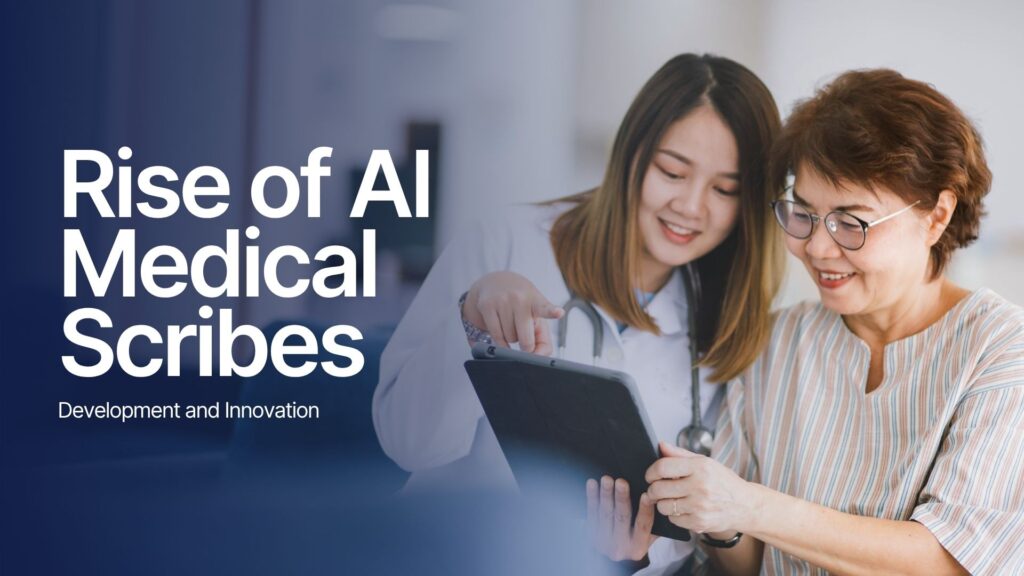
Healthcare organizations must prioritize efficient documentation processes because digital technologies have transformed their operations. The Custom Software Development Services create intelligent medical scribe software solutions according to their required specifications. A medical scribe system enables clinicians to document patient encounters during live sessions which decreases their administrative work while enhancing their ability to deliver medical care. Healthcare organizations can develop customized scribe platforms through Custom Software Development Services that meet their compliance needs and expand their operations while working smoothly with their clinical processes.
Medical scribe software has evolved from simple transcription tools into advanced AI systems that understand context and extract clinical insights and create documentation automatically. The current systems of healthcare software applications now meet the requirements for efficiency and compliance and interoperability standards for software applications.
Working of Medical Scribe Software
The medical scribe software operates through its ability to record doctor-patient interactions and create structured clinical documents from that data. The process requires three main components which include:
- The system uses advanced voice recognition technology to transcribe speech into text.
- The system uses Natural Language Processing (NLP) technology to understand medical terms.
- The system creates structured Electronic Health Records (EHR) through contextual analysis.
- The system uses automation workflows to optimize the process of creating documents
Modern systems rely on AI models which clinical datasets trained to deliver accurate results. The IBM overview of NLP in healthcare provides complete information about clinical NLP applications for users who want to study this subject deeper.
Organizations can create systems that meet their specific needs through Custom Software Development Services which allow them to create specialty software systems for fields like cardiology and dermatology and radiology.
Types of Medical Scribes: Human-Assisted vs AI-Powered Solutions
Medical scribe solutions fall into two primary categories:
1. Human-Assisted Scribes
Trained professionals document patient interactions through manual documentation. The method achieves accurate results but requires excessive resources which limit its capacity for expansion.
2. AI-Powered Scribes
The future of technology will use AI-driven systems. The following systems exist:
- AI-powered medical scribe software capable of real-time transcription
- Digital medical scribe system solutions which EHR platforms use for their operations
- Healthcare organizations use automation tools which employ robotics process automation for their operations
AI-powered scribes provide organizations with cost savings and better scalability options when compared to traditional systems. The systems have become preferred by organizations because they enable complete automation through their capability to work with top RPA software used in healthcare.
Emerging Trends in Healthcare: AI, Voice Recognition & Ambient Computing
The healthcare field is experiencing fast technological progress because medical scribe software currently drives multiple new developments:
AI Integration
AI technology improves clinical accuracy through its ability to detect patterns within patient medical records. The scribe systems use AI-Powered Medical Claims Processing Bots as their automated billing systems which help handle billing tasks.
Voice Recognition
The advanced speech recognition systems of today can create accurate real-time transcriptions even during noisy clinical settings.
Ambient Computing
Ambient clinical intelligence enables systems to record doctor-patient interactions through their listening capacity without needing to interrupt the process. This function represents a fundamental component of the leading AI medical scribe software.
For insights into ambient clinical intelligence, check this Microsoft healthcare AI resource.
The implementation of these innovations requires Custom Software Development Services which provide customized solutions that meet regulatory requirements.
Core Features of Medical Scribe Software
A complete medical scribe solution needs to provide:
- AI-based transcription system that operates in real time
- NLP engine for processing medical information through clinical language understanding
- A system that enables electronic health record systems to connect with other software applications
- A system that allows users to control functions through voice recognition
- A system that protects data while meeting HIPAA security standards
- Intelligent automation services provide organizations with tools to automate their complete operational processes.
Advanced systems use clinical workflow automation software to enhance their processes for handling patient records and office work.
Integration with Healthcare Systems
Integration serves as essential element for constructing medical scribe software. The systems need to achieve seamless integration with the following systems:
- Electronic Health Records (EHR)
- Hospital Management Systems (HMS)
- Billing and insurance platforms
- Telemedicine applications
Developers can establish system interoperability through Custom Software Development Services by implementing HL7 and FHIR standards. Integration provides healthcare organizations with ability to combine their systems with robotic process automation which streamlines their administrative processes for tasks like appointment scheduling and claims processing.
Benefits of Medical Scribe Software
The implementation of medical scribe software brings multiple advantages to healthcare organizations which include:
Improved Efficiency
Doctors spend their time mainly on patient interaction while they complete necessary documentation work.
Better Patient Experience
Doctors can focus entirely on patient interaction.
Scalable Operations
AI systems can easily expand their operations to different departments and facilities.
The maximum benefits from these solutions occur when organizations develop their systems through Custom Software Development Services which enable complete alignment with their business requirements.
Challenges in Building Medical Scribe Software
Medical scribe software development faces difficulties that exist despite its beneficial aspects.
Data Privacy & Compliance
The healthcare industry needs to follow HIPAA and GDPR regulations for its operations.
Accuracy of AI Models
Medical professionals need advanced AI systems that require extensive training to understand medical terminology.
Integration Complexity
Connecting with older systems requires extensive technical expertise.
High Development Costs
Organizations need to spend a lot of money for developing AI-based systems.
User Adoption
Without adequate training medical professionals will not accept new technological solutions.
Organizations use Custom Software Development Services together with intelligent automation Services to overcome their existing challenges by developing effective user-friendly systems.
How Do You Build Medical Scribe Software for Healthcare Systems?
The development of medical scribe software requires developers to follow a systematic process which includes the following steps:
Requirement Analysis
The process requires identification of clinical workflows together with their respective documentation requirements.
Technology Selection
The system will employ artificial intelligence together with natural language processing and cloud computing platforms.
UI/UX Design
Healthcare professionals need user-friendly interfaces which the design process must create as its main objective.
Development & Testing
The team will develop new functions while verifying their correct operation.
Integration
The system connects with electronic health record systems and multiple healthcare operational systems.
Deployment & Maintenance
The system needs constant updates to maintain compliance with existing regulations.
The Custom Software Development Services provide complete customization which meets all healthcare industry standards.

What Technology is Used in Medical Scribe Software Development?
Key technologies include:
- Artificial Intelligence & Machine Learning
- Natural Language Processing (NLP)
- Speech Recognition APIs
- Cloud Computing (AWS, Azure, GoArtificial Intelligence & Machine Learningogle Cloud)
- Robotics Process Automation in Healthcare
- APIs for EHR integration
The technologies enable modern AI medical scribe software to function while providing complete automation capabilities.
What is the Future of Medical Scribe Software in Healthcare?
The future of medical scribe software develops through four main technological advancements which include:
- Fully autonomous AI scribes
- Integration with wearable devices
- Predictive analytics for patient care
- Expansion of Top AI medical scribe solutions
- Increased use of AI-Powered Medical Claims Processing Bots
Healthcare organizations will implement advanced Digital medical scribe system solutions because of ongoing AI technological progress.
How is Healthcare Automation Transforming Clinical Documentation?
The process of clinical documentation works through automation which creates the following benefits:
- The process eliminates manual data entry work
- The process helps reduction of physician burnout
- The process achieves better data accuracy results
- The process develops better workflow efficiency through clinical workflow automation software
The best RPA software for healthcare implementation streamlines administrative processes while creating more efficient healthcare systems which put patient needs first.
Conclusion
The implementation of medical scribe software in contemporary healthcare systems leads to better operational efficiency and precise documentation which results in improved patient treatment outcomes. The development of these systems needs both strategic planning and advanced technological solutions and specialized industry knowledge. Custom Software Development Services exist as vital tools for building custom software solutions. The combination of AI technology with intelligent automation services will enhance performance of healthcare documentation systems according to organizations handling health records.
Healthcare organizations need to adopt AI-powered medical scribe software together with automation systems because these technologies will help them maintain competitiveness while providing excellent patient care. The AI-driven capabilities of medical scribe software together with automation systems will become needed. AI-powered medical scribe software and automation systems serve as essential tools that healthcare organizations must implement to maintain their competitive position while delivering superior patient care.
FAQs
How do you build medical scribe software for healthcare systems?
What technology is used in medical scribe software development?
What is the difference between AI-powered and human medical scribes?
What are the advantages that a digital medical scribe system brings to its users?
What is the future of medical scribe software in healthcare?