

Government schemes are designed to help people. But there can be a surprisingly long road from announcement to delivering that benefit to the decision-maker.
Applications need to be received. Documents need to be checked. Eligibility needs to be verified. Data needs to be entered across multiple systems.
Applications move through approval stages. Payments need to be processed. Finally, citizens need updates.
Imagine doing all that for thousands—or, in fact, millions of people?
That is where delays, human errors, duplicates, overlooked information and payments may arise. If you are a government employee, you might need to open multiple hundreds of applications, import and copy data from system A to B, look at the same rules over and over again and send out status updates individually. To be frank, anyone we know would also get bored of copying the same data for the 500th time, even if they are a hustle monster.
This is where RPA Services in USA and global automation solutions can help you modernise the operations of the public sector.
Robotic process automation, or RPA, is a process of using software bots to automate repetitive, rule-based digital tasks. These bots are able to log in to systems, gather information, verify data, transfer records between applications, perform repetitive checks, build reports and send notifications.
To put it simply, much of the previously performed repetitive digital work behind a government scheme can now be taken care of by RPA.
That would be a monumental opportunity. The Ministry of Finance’s official Public Financial Management System data indicates that India’s Direct Benefit Transfer ecosystem supported 966 schemes in FY 2025-26, featuring a total of 210.56 crore transactions and payments amounting to ₹2.87 lakh crore to beneficiaries by December 2025.
At that scale, even the tiniest of manual mistakes have the potential to turn into an enormous issue.
This is not just a problem of India. Due to its reliance on estimates, the US Government Accountability Office (GAO) estimated improper payments of about $186 billion were made across 64 federal programs that year for FY 2025, with approximately 82% of those dollars attributed to overpayments. This does not suggest all improper payments are merely human error, but it certainly indicates the great need for tighter validation, monitoring and process controls in large public programs.
This is where RPA in government schemes goes beyond a mere technology trend. It thereby provides an efficient method to automate repetitive processes, while freeing up government employees for the cases and citizens that require a little more attention.
The key point is: RPA should not be replacing the government employee or the hiring system at hand. In short, it typically works with software that already exists and is utilised to bridge the gap between repetitive steps that employees currently still perform manually.
Government workflow automation can be achieved by using RPA, from scheme applications and eligibility checks to subsidy processing and payment reconciliation — making them faster, consistent, and long-trackable.
So, let’s understand exactly how this works.
What Is RPA and How Does It Work in Government?
Robotic Process Automation is the software that executes pre-defined digital jobs by following programmed instructions.
An RPA bot can be seen as a digital worker who is the most disciplined of all.
It does not require a coffee break. It doesn’t complain about data entry redundancy. And most significantly, it will perform the same approved process thousands of times, without suddenly deciding to invent something new.
The most important difference between an RPA bot and a human employee is that a bot knows only what it has been programmed to do.
One of the example of what an RPA bot is asked to:
- Open a government application portal.
- Get data from an example.
- Validate the presence of required fields
- Compare information against predefined records.
- Pass verified data to another system.
- Verify if mandatory documents are attached.
- Flag missing or inconsistent information.
- Route case to appropriate Department
- Update an application’s status.
- Trigger a notification.
- Prepare information for payment processing.
- Reconcile completed transactions.
- Generate reports and audit logs.
Because most administrative activities are repetitive and rule-based, RPA is particularly helpful for government processes.
How does an RPA workflow work?
Your basic workflow may look something like this.
Citizen application → Data to bot → Document verification → Information verification → Rules for eligibility applied → Exception goes to human officer → After approval, moves to payment module→ Payment status updated→ Sends Notification to citizen
Not all the decisions are made by the bot.
Rather, it deals with the steps around the decision that you can expect.
For instance, when an application is complete and has a bright-line test indicating it meets certain criteria set in advance, the system may approve it. And if any information is not supplied, is inconsistent or raises suspicion, the chatbot can halt the process and transfer the case to a verified employee.
This is called an exception-based approach.
This is among the most secure methods of applying automation to public services since simple situations may be expedited even as complicated cases receive the correct human attention.
Can RPA work with old government systems?
Yes, and this is one of its major advantages.
Government departments many times have disparate systems from multiple stages in time. One department may be using a modern web app, another a legacy desktop system, and they might be maintaining some records in spreadsheets.
It can take years and a hefty sum of cash to replace everything.
RPA tends to simulate the same actions a human employee takes using existing systems, so RPA can often interact with these systems as though it were the person acting. In cases where APIs are accessible, direct integration may be more effective, possibly even more so than comparably-priced and lower-cost COTS products. In their absence, well-designed bots may integrate with the established UI.
This makes RPA a high-value, tactical assist on the path to modernisation over time.
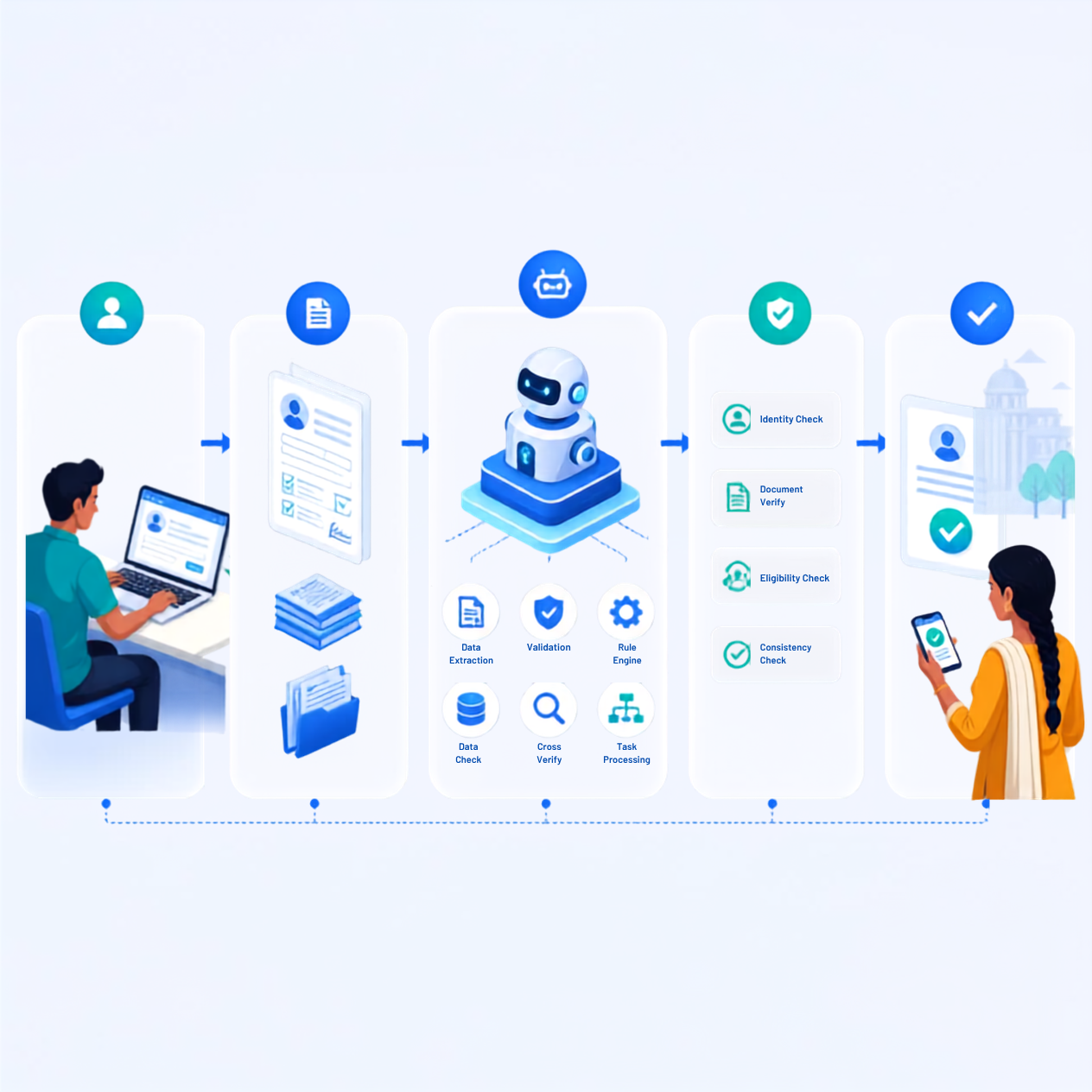
How RPA Automates Government Scheme Applications
The first key area of opportunity is in application processing.
You can apply for a government scheme through a website, mobile application, email, local service centre, or even a departmental system.
Behind every application, there may be several manual steps.
Someone verifies documents. Another individual feeds the information into another system. Someone checks eligibility. A person submits the case for approval.
Now replicate that process a hundred thousand times over.
That is one reason why automation fades out from looking like a luxury and breaks in as a necessity.
Step 1: Automated application intake
This feature allows RPA to pull information from incoming applications and fit it into the right system.
The bot has to be trained to check things like:
- Applicant name.
- Application ID.
- Scheme selected.
- Contact information.
- Mandatory fields.
- Required documents.
- Submission date.
- Application completeness.
If a document is necessary but not present, it can automatically flag the application as incomplete and send out a message that asks for additional details from the applicant.
This prevents the need for government employees to manually check all the straightforward completeness questions.
Step 2: Data extraction and entry
Manual data entry is one of the most common administrative tasks in large organisations.
It is also one of the easiest tasks for performing repetitive errors
RPA bot can filter out structured data and feed it, of course, into systems based on predefined rules.
If a document contains unstructured information, then RPA can be combined with OCR (Optical Character Recognition) or Intelligent Document Processing technology.
For example:
Upload document → OCR reads the document → Extraction of field data → Transfer of information by RPA → Validation rules verify the data
The result is not just a rapid input of data. This can also bring about a more consistent procedure.
Step 3: Automatic Data Processing via E-Mail
Filing applications, queries, supporting documents, and follow-up requests in government offices results in huge volumes of emails.
Employees will often need to read every message, download attachments, see the case it relates to and find who should handle that case on their own without automation.
This is work that can be lessened with Automated Email Information Processing.
A bot that looks over a specific inbox to detect messages meeting certain conditions. It is capable of downloading attachments, parsing relevant information, linking documents to a pre-existing case and routing exceptions to an appropriate member of staff.
As an illustration, an email titled “More Support Documents for Application No. 12345” could be automatically associated with the corresponding application.
Naturally, a bot should not be expected to just interpret all complex email content as a government officer consultant of policy with 20 years of experience. That’s where AI and human review can come in.
Step 4: Application routing
Just after an application has been examined, RPA can route it in accordance with principles.
An entire application of a routine might even advance to the next phase without human intervention
An application that lacks information might be put into a correction queue.
A potential duplicate would fall into a verification queue.
You can assign a government officer to a complex case.
This will maintain continuity by not having people wait unnecessarily between specific steps of an administration process.
Step 5. Automating Document Verification and Eligibility Checks
The first question comes in mind and you might ask is:
Can RPA automate government scheme eligibility checks?
The short answer is yes—but only to the extent that we know which aspects of eligibility can be automated.
RPA works best for well-defined, rule-based checks.
Imagine a scheme that demands that an applicant fulfil certain clearly documented requirements, and the system is able to gather necessary data and then compare it to pre-approved rules.
For example:
If condition A is met + condition B is met + document C is valid → Process continues.
As a result, it will be flagged if that information does not match the application.
The outcome can be:
Eligible → Move forward
Ineligible based on clear rule→ Indicate the reason as per the approved process
Doubtful or contradictory information → Direct to Human Officer
That last step is important.
Government benefits can change people’s lives. When a case is complex, data is ambiguous, or policy interpretation is required – the bot should not be treated as an infallible arbiter of decisions.
Step 5: Detecting duplicates and inconsistencies
RPA can check records across systems and highlight problems that are likely to occur.
For example, it can flag:
- Duplicate applications.
- Repeated beneficiary records.
- Missing bank information.
- Inconsistent personal information.
- Applications submitted multiple times.
- Records that require further verification.
Strong beneficiary validation is a lesson from India’s governance reforms and the (compared to India) modest Direct Benefit Transfer (DBT) switchover. By the end of January, 2019, the Government of India reported official DBT estimated gains data through various reforms such as beneficiary cleaning that led to deleting approximately 6.36 crore duplicate and fictional and/or non-existing ration cards, bringing estimated cumulative benefits under PDS to around ₹3.13 lakh crores up until March 2025.
RPA is helpful for this kind of process because it can easily automate comparisons and identify what is suspicious or duplicate.
But there is a vast difference between flagging something as a possible duplicate and showing that someone was to be declared ineligible.
The first can usually be automated.
Whereas the second will need to be investigated and require human judgement.
That distinction can shield public funds and real beneficiaries.
Step 6: Streamlining Approval and Subsidy Disbursement
Once the eligibility and verification checks are done, an application might enter the advance approval and payment stage.
Another aspect here is making repetitive tasks go away through automation.
An RPA workflow can:
- Update application status.
- Generate approval records.
- Route cases to authorised officers.
- Prepare payment data.
- Check whether mandatory approvals exist.
- Process approved payment commands.
- Monitor payment responses.
- Reconcile successful and failed transactions.
- Update beneficiary records.
- Send status notifications.
The workflows backed in the system should be through approved business rules, along with access based on roles, segregation of duties and audit logs.
How RPA helps reduce errors in subsidy processing
The answer is simple: consistency.
The human workers are likely to get tired and exhausted by end of the workday. It might accidentally skip a repetitive step.
Someone may misspell a number.
A bot designed correctly should follow the same instructions and perform the task.
The bot can check whether:
- A payment has already been triggered.
- Required approval exists.
- Beneficiary details are complete.
- The amount matches approved rules.
- A transaction has failed.
- Reconciliation is required.
This is important because payment integrity is one of the biggest problems around the globe.
Citing a broader analysis of FY2025 payment integrity that the U.S GAO performed, it said there were approximately $186 billion in improper payments spread across 64 federal programs; of these, at least $153 billion were categorised as overpayments.
A $186 billion problem that RPA Alone cannot solve. That’s asking a little too much of any one piece of software.
Automation can, however, help reinforce repetitive controls to make sure validation steps are always done properly and treat exceptions for review with urgency.
Benefits of RPA for Government Departments and Citizens
RPA is not merely about “doing faster”.
The actual benefit comes from making better use of government resources.
Faster processing
Routine applications can pass through stages repetitively without waiting for input from someone who must hand-type data.
This allows your employees to concentrate on applications which actually require their attention.
Better citizen experience
Now, let’s understand “how RPA improves citizen services?”
- Routine administrative work being faster means citizens might get.
- Faster application acknowledgements.
- Quicker status updates.
- Less delay due to manual routing.
- Faster identification of missing documents.
- More consistent communication.
- More visibility into the processing journey.
For the person awaiting a subsidy, pension payment, grant or welfare benefit — these improvements are not simply technical.
A late payment, it can affect an actual family, an actual company or a real person struggling with daily living.
Which is why good government automation should always centre on outcomes rather than cool technology dashboards.
More accurate and consistent processing
A recent example of large-scale automation comes from the U.S. Department of Veterans Affairs, claiming it has already used bots to help extract veterans’ relevant information from radiology reports. The automation initiatives achieved 99.9% accuracy on community care claims , redirected 133k employee hours to higher-level work, and enabled further auto-adjudication of 3 million more claims with an accuracy rate of 98.5% in 2021. This illustrates an important point.
The value of automation comes into its own when it frees skilled workers from repetitive work so they can spend a greater fraction of their time in the realm where human judgment matters most.
Better audit trails
Government processes require accountability.
The logs that can be generated by a well-architected RPA workflow are:
- When a case was received.
- Which validation steps were completed.
- Which system was updated.
- When a case changed status.
- Whether an exception occurred.
- Who approved a critical decision.
It can simplify investigations, audits and process monitoring.
Real-World Use Cases of RPA in Government Schemes
The possible use cases are so much more than one specific type of benefit.
Welfare and social assistance
RPA can help with application intake, document checks, routine eligibility verification, payment preparation and case updates.
Subsidy processing
In the case of subsidies, for example, bots can automate some aspects of repetitive checks before payment while keeping an eye on transactions post-disbursement.
Pension administration
Automation can streamline mundane applications, document verification, data entry, record-keeping and other repetitive activities that are often form-based, where the candidate must come in to apply for a position.
Tax and revenue administration
It can assist in reconciliation, validation of data & records, reporting, notices and routing cases.
This is also where the keyword RPA Bots Handle Complex VAT, GST, and Sales Tax Calculations are to be interpreted with care. Bots can decide what data to collect, validate and reconcile based on the rules that are approved within a certain system. A manual process will tell you what to gather in a document as well as provide a way for humans with limits to enact decisions. On the other hand, complicated tax interpretation should continue to be handled against proven tax logic and proper human or expert intervention.
Grants and public funding
Government departments can automate:
- Grant application intake.
- Document collection.
- Completeness checks.
- Eligibility rule checks.
- Approval routing.
- Payment status updates.
- Reporting.
Citizen communication
Bots can initiate automated receipts and status alerts.
This comes especially handy when citizens otherwise are left to keep asking: “What’s up with my application?”
And yes, making it so that a citizen only has to ask the question once is an important gain in public service.
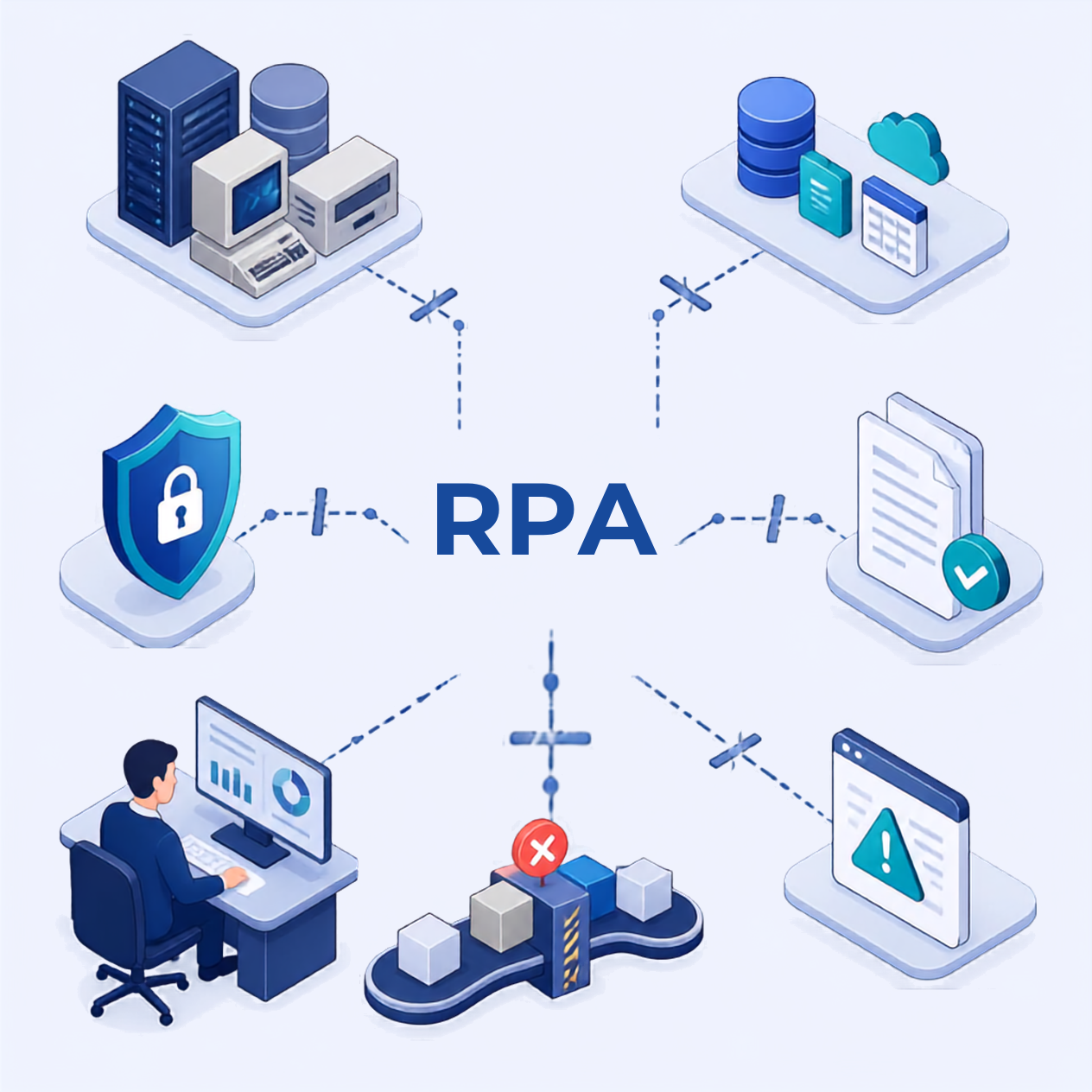
Challenges and Considerations in RPA Implementation
RPA can be powerful, but automation should not be used blindly.
Automating a poorly designed process simply allows the poor process to run faster.
Departments should also review the workflow itself before implementing it.
Here are some of the challenges and risk of implementing RPA. These are a s follows:
1.Start with the right processes
Good candidates are usually:
- High-volume.
- Repetitive.
- Rule-based.
- Digitally accessible.
- Stable enough to automate.
- Currently consuming significant employee time.
2. Data quality matters
Automation with bad source data is very efficient at generating crap.
Which is exactly why validation, data governance, and exception management are so important.
3. Security and privacy
Government systems handle sensitive information.
Strong access controls, authentication, logging, encryption (if relevant), credential management and monitoring, and unequivocal authorisation policies should be included in RPA implementations.
4. Policy changes
Government schemes change.
Eligibility rules can change. Required documents can change. Payment amounts can change.
Hence, bots require governance and upkeep.
An automation that worked six months ago can become wrong if the policy updates.
5. Human oversight remains essential
This is crucial just for high-impact or complex decision-making.
The best approach is often:
Automate ordinary operations → Identify deviations → Forward difficult cases to humans → Retain an audit record
This finds a balance between efficiency and accountability.
When assessing providers, government bodies may benchmark against India’s Top RPA firms, along with those RPA business solutions companies, or vendors of Agentic AI Services and Solutions. But the best question, of course, is not just who has the biggest marketing claim.
Actual public-sector experience, security, scalability, integration capability, governance and support should all be evaluated with regard to the ability of an organisation to maintain automation as regulations change.
Future of RPA in Government Schemes and Subsidy Processing
Government automation of the alone.
More and more, it will involve multiple technologies combined.
RPA will be executed for structured and repetitive tasks.
The reading of documents will be facilitated through OCR and Intelligent Document Processing.
AI can assist you in understanding information and discovering trends.
Anomaly detection can be supported by machine learning.
Modern systems can talk to each other directly through APIs.
They can manage end-to-end processes because they have built-in workflow platforms.
So agentic systems will probably end up doing more heavy lifting in dynamic multi-step tasks, but they are going to do that logic with strong governance and human controls in our government cages.
This is the reason RPA Services in USA are increasing gradually and moving away from screen automation and approaching intelligent automation ecosystems.
Imagine the future workflow:
- A citizen submits an application.
- The system reads the documents.
- Data is extracted automatically.
- Rules validate the application.
- RPA transfers data from one government system to another.
- Potential anomalies are flagged.
- Missing information is requested automatically.
- Routine cases move forward.
- Authorised officers deal with the more complex cases.
- All approved payments, however, are routed through established payment infrastructure.
The transaction is then reconciled, and the citizen gets updated.
That is the path for intelligent workflow automation of the government.
However, speed should never trump fairness, privacy, security and accountability.
Conclusion
So, if you want to talk about the processing of government schemes, benefits & subsidies at its core, how could RPA automate that process?
It can automate repetitive tasks throughout the process.
It handles tasks like application intake, data entry, document processing, rule-based eligibility checks, duplicate detection, approval routing (in some cases), payment preparation and reconciliation (in conjunction with other tools), notifications and reporting.
Why is this such a large opportunity?
Government programs are by their nature, at enormous scales. Take India’s DBT ecosystem, for instance: it has dealt with orders of magnitude greater beneficiary transactions, and official Government data states cumulative DBT transfers exceeding ₹53 lakh crore and estimated gains exceeding ₹5.14 lakh crore from DBT plus associated governance reforms.
The lesson is clear.
Just because AI and RPA are popular does not mean that government departments need it!
When it just works & solves a real problem for them, they need it.
The best bot strategy is to identify rote work, select specific steps, confirm their reliability, protect sensitive information, assess the effectiveness of your bots and keep people in the mix where judgement is key.
RPA business solutions company and similar intelligent automation capabilities can particularly assist public-sector organizations process work faster and more consistently when used correctly. More crucially, they can reduce the time employees spend duplicating data across screens and give them more time to assist citizens and solve challenging cases.
After all, technology works best when you barely notice the automation at all.
But they see that the government service took less time, was simpler to navigate, and people got to where they needed to get with much fewer errors and unnecessary delays.
FAQ
How can RPA automate government schemes?
How effective is RPA for automating government scheme eligibility checks?
Can RPA work for large-scale government benefit programs at scale?
How RPA minimises errors in subsidy processing?
How does RPA add value and improve citizen services?