

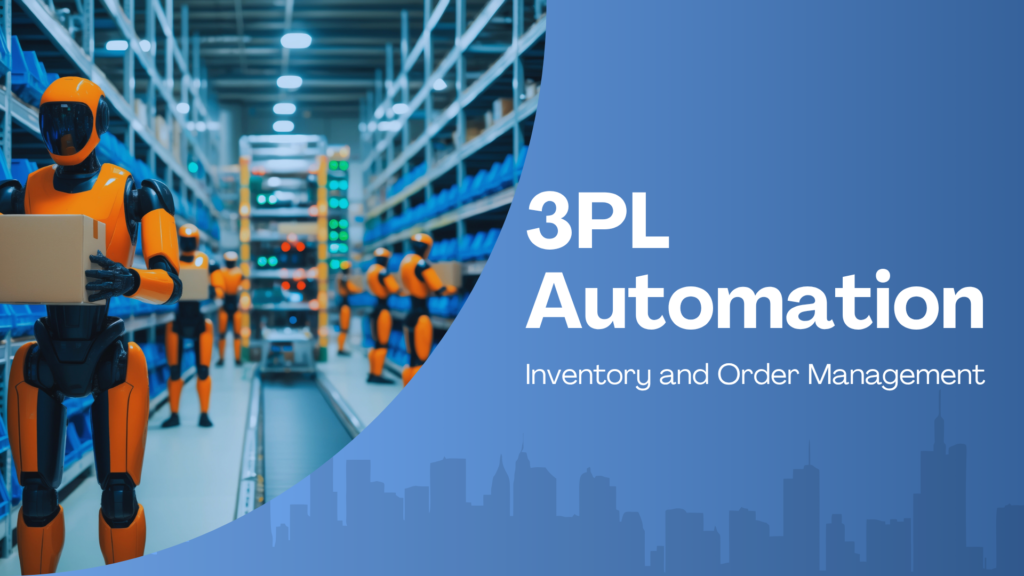
3rd Party Logistics (3PL) providers handle inventory, storage, fulfilment of orders, shipping of products and returns for many businesses. When order volumes increase, spreadsheet and paper-based processes as well as repetitive data entry can make an easy warehouse task a costly operational headache.
This is where RPA Services in USA warehouse management systems, artificial intelligence, robots, IoT and system connections can make a difference. Automation links inventory orders, warehouse actions and shipping details so everyday tasks can be done faster and with mistakes.
And the trend is already happening in the industry. According to Inbound Logistics’ 2026 3PL research, only 87% of those surveyed provided Transportation Management Systems (TMSs), 83% provided Visibility options, and 73% provided ERP & 72% WMS/WES capabilities and 74% of respondents provided inventory management.
Which brings us to the real question: 3PLs should no longer be asking whether or not they will automate. It is what processes should be automated first, and how do you see the technology yielding measurable business value?
Understanding 3PL Inventory and Order Management
In a 3PL, inventory management consists of Receiving of products, product storage, tracking of quantities and location, restocking items, cycle counts for locations with frequent stock up, and pre-shipment stagings.
Order management starts once a customer order comes to the system and goes through inventory allocation, picking, packing, shipping tracking, and returning.
The challenge is complexity. One 3PL may manage thousands of SKUs across many different customers and SKU sets for each customer with unique products, SLAs, packaging requirements, inventory rules and shipping preferences.
Modern 3PL Technology Connects Systems like:
- ERP
- Order Management System (OMS)
- Warehouse Management System (WMS)
- Warehouse Execution System (WES)
- Transportation Management System (TMS)
- eCommerce platforms
- EDI and APIs
- Barcode and RFID systems
Let’s say an order flows from an eCommerce platform, comes into the OMS automatically, hits the WMS to check inventory, creates a picking task and produces shipping information while also sending track details back to the customer.
It saves repetitive work and provides all of the stakeholders with reach to more consistent information.
Role of Automation in 3PL Operations
Why is automation important for 3PL companies?
The short answer: speed, accuracy, scale and control of costs.
Automating repetitive tasks like getting data, validating orders and updating inventory, creating picking jobs, generating shipping labels and providing status notifications.
Automation does not necessarily mean robots — this is crucial. Automation is not having a barcode scanner against a WMS. An API that transfers an order automatically between an eCommerce platform and a 3PL system is too.
According to the 2025 Warehouse/DC Operations Survey, 87% of respondents used some form of WMS. The survey also showed 18% utilisation of AMRs/AGVs, 18% use of shuttles or automated storage and retrieval systems and 13% utilisation of autonomous forklifts. However, 40% still leveraged some paper-based picking.
That gap is important. Most warehouses are not completely automated, instead replacing the most inefficient manual tasks step by step.
Automated Inventory Tracking
The basis for accurate fulfilment is inventory accuracy.
Just think about having made a promise to the customer for 100 units because the system said that it has 100 available while in fact, only 85 were there. The issue isn’t just an incorrect digit. Such mismatches can result in orders that are missed, made late due to cancelled applications called for on emergency delivery- this is all a recipe for lost trust with customers.
This risk is reduced by tracking inventory automatically.
Barcode and RFID
With the help of barcode and RFID items can be verified and scanned when they are received, moved, picked, returned or shipped. The WMS automatically updates inventory records and that really improves efficiency of the process.
In addition to providing another method of identification, an RFID solution can help track goods faster in an appropriate warehouse environment.
According to the 2025 3PL market research, 49% of those surveyed indicated that their 3PL has RFID capabilities, while just 35% noted IoT/IIoT capabilities.
Automated cycle counting
Rather than pausing to conduct a large physical inventory count, the WMS software can schedule cycle counts based on product value or other rules like frequency of movement or the sighting of previous discrepancies.
More than three-fourths of the 184 survey respondents in the Warehousing and Distribution Center (DC) study indicated they used inventory accuracy as a way to measure distribution-centre performance, according to an industry-raised poll by Modern Material Handling in comparison with findings from the prior year’s Warehousing/DC survey, which revealed that ratio was just over 70 per cent.
AI-driven inventory management
Through historical orders, SKU velocity analysis, lead times and seasonal patterns, it has the ability to see where potential shortages or excess stock are likely.
This shifts inventory management from simply asking — “What do we have?” instead of saying: What do we need next?
Automated Order Processing and Fulfilment
Order intake is engaged in automated order fulfilment.
The orders can come from eCommerce platforms along with different marketplaces, ERP systems, EDI connections or also from customer portals. Then integrations can import this information directly into the OMS or WMS.
The system can then:
- Validate the order.
- Check inventory.
- Allocate stock.
- Select the appropriate fulfilment location.
- Generate picking instructions.
- Confirm picked products.
- Create packing and shipping information.
- Send tracking details.
- Automated picking
3PL systems leverage several technologies, such as:
- Pick-to-light
- Voice picking
- RF scanners
- Batch picking
- Zone picking
- Goods-to-person systems
- AMRs and AGVs
- AS/RS
- Robotic picking
Batch picking was utilised by 48% of those surveyed in the 2025 survey, and though single-order picking still had a great deal of traction (65%), it ultimately resulted in losses.
In manufacturing and logistics, these principles are fundamental to robotics process automation too while collaborating with RPA services in USA. Rule-heavy repetitive tasks are low-hanging fruit for automation while humans are essential for judgment-laden exceptions.
Benefits and Merits of Automation
1. Lower fulfilment costs
How can automation reduce fulfilment costs?
It has the potential to lower repetitive tasks, cut down on picking and shipping mistakes, reduce unnecessary travel waste in a warehouse, make better use of the inventory in the warehouse and finally maximizing throughput.
That said, you don’t buy automation just because the technology is cool. The metrics should be present and reflected in the business case and would amount to tangible improvements in cost per order, labour hours, accuracy, throughput, and cycle time.
2. Faster fulfilment
Pageless automated workflows eliminate excessive handoffs and manual data entry. This makes for faster progression from receipt to lid.
3. Better inventory accuracy
Constant scans and updates of systems decrease the likelihood of inventory records becoming outdated.
4. Greater scalability
Order volume can assume sharp increases during holidays, promotions and seasonal peaks. It enables 3PLs to scale their capacity without adding manual work at linear velocity.
5. Better visibility
Allows shoppers to get updates on inventory, order status, shipments and exceptions more quickly.
6. More productive employees
Automation allows people to do repetitive work, and humans can just focus on quality checks, customer service-related issue handling, managing exception cases and operational decisions moving forward.
And this is where Smart Process Automation really comes into play. The point is not to throw people out of a process. Remove the unneeded work so that people only focus on work that legitimately requires a human being to do.
One of the aspects related to the benefits – if we analyse some RPA Services in USA, automation is not just limited to warehouse activities, it can also be an automated invoice processing addressing document handling solution (inbound mails etc), reporting, talking with customers and repetitive back-office operations.
Challenges in Implementing Automation
Automation is strong, but it is not a miracle. With proper planning and better strategy, automation can fundamentally change the working of entire business with much higher accuracy, efficiency and increase productivity which will results in form of profit.
Integration problems
In business information must flow accurately between WMS, OMS, ERP, along with TMS, robots, eCommerce platforms and carrier systems. The absence of integration can result in new bottlenecks.
Data quality
Behind every automation is a dataset, which determines how foolproof the outcome will be! Automated decisions can fail when SKU dimensions, inventory quantities, product information or customer rules are not correct.
In the 2025 warehouse survey, only 57% of respondents even reported having 100% accurate SKU weights and dimensions information in their inventory item master.
Initial investment
Costs may involve software, hardware, robotics, integration costs and training and maintenance solutions, including those with cybersecurity capabilities to ensure smooth running.
Employee adoption
Staff need training and simple processes. The WIN criteria for automation success require the fusion of technology and human expertise, not an ‘afterthought’ to workers.
Choosing the right technology
Not all the third party logistics systems need advanced robotics. You can definitely see the amazing improvements already, with WMS, barcode scanning, APIs and workflow automation.
Even the workflow apps, dashboards, integrations, and automated processes can be created and developed quickly with the advancements in low-code no-code development services without building everything from scratch.
In this context, Custom AI chatbot Development can assist customer-service teams by responding to order-status inquiries, delivering shipment details, and directing intricate problems to personnel.
Hence, Top RPA Firms in USA should be assessed based on their knowledge of 3PL processes, integrations and data on which their automation will run, security requirements and measurable outcomes—not merely the volume of automation tools they market.
Conclusion
The future of 3PL logistics is becoming more seamlessly integrated, intelligent and automated.
The operational backbone is done using WMS and OMS platforms. Carrying on with the theme of data, barcode and RFID along with 3PL technology are actually improving how all this knowledge is captured. APIs and EDI connect systems. By frequently doing repetitive physical tasks, robotics is responsible for fulfilling that work, whereas AI detects patterns and anticipates demand by provisioning crisp decisions with the help of RPA services in USA.
So where is the future? AI and automation in 3PL.
Is progressing beyond simple task automation to predictive and ultimately autonomous operations. AI identifies inventory risks and fulfillment exceptions, while robotic systems execute repetitively manual physical tasks.
The opportunity for 3PLs is not automating everything. It is to automate the right thing which requires automation.
When 3PL providers have a solid process strategy, trusted data, seamless systems and clear KPIs (regardless of the plan they choose), robotic process automation in manufacturing can optimize inventory accuracy, fulfillment costs, operational speed and scale without letting complexity substitute themselves in their warehouse.
FAQs
Why is automation important for 3PL companies?
What are the tools that 3PLs use for automation?
How can automation help reduce 3PL fulfillment costs?
Can AI help optimize Inventory Management for 3PLs?
How does automation play into the future of 3PL logistics?