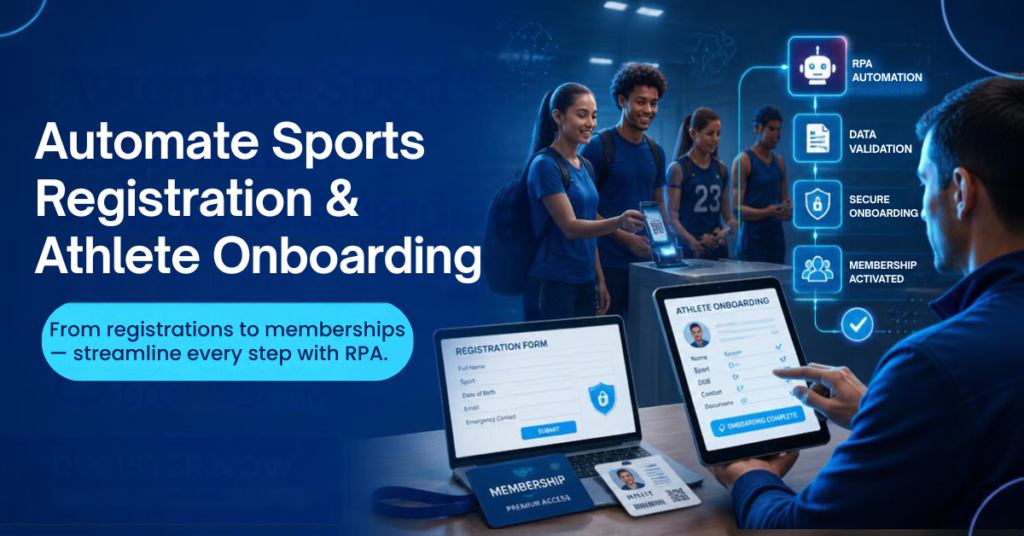
From the outside, sports administration looks easy and it looks exactly like this where an athlete fills out a form, pays a fee, uploads documents, and gets registered.
But behind that simple experience is a lengthy chain of administrative work.
Staff have to repeat the same info in different systems, check eligibility, validate documents, reconcile payments, update membership records, and send emails and reminders for missing information.
The scale is also growing. As per the Sports & Fitness Industry Association’s 2026 participation report, in 2025, over 250 million Americans played at least one sport, fitness or leisure activity, with overall participation up by 1.2% year on year.
Greater participation means more registrations, memberships, payments, and records to handle.
That is precisely where Robotic Process Automation (RPA) Development Services does pragmatic magic. While RPA machines can perform repetitive physical functions in the data domain, human experience, decision-making and human-to-human interaction tasks are still largely managed by people.
Why is Sports Registration and Athlete Onboarding becoming more Complex?
Modern sports registration is much more complex and involves more than simply taking an athlete’s name and phone number.
The process involves, depending on the organisation and sport, like:
- Personal and contact information
- Verification of age group and Date of Birth
- Identity information
- Membership categories
- Registration fees
- Payment confirmation
- Consent and waiver forms
- Medical or eligibility documents
- Background-check information
- Licenses and certifications
- Team or club allocation
- Renewals and expiry dates
- Competition eligibility
- Athlete communications
Storing information in different systems can make things even more difficult.
A registration record may be contained in one system. Another handles payments. One stores documents, another manages memberships.
Someone needs to ensure the agreement of all these systems.
And that is where the true administrative nightmare starts.
A good example of this trend of how mass-sport registration is becoming systematically organised is FIFA Connect. It aims to create a global football ID — linking member associations via its global registration system, clearing data silos and decreasing person duplicates.
There is a broader rationale for bettering sports participation infrastructure. According to physical activity data from the World Health Organisation, 31% of adults in the world and 80% of adolescents do not meet recommended levels of physical activity
This is a great lesson in case you had any scepticism about whether it really matters to get people into sport — and once they are there, making registration and participation easier fits within that wider ecosystem.
What Is RPA and How Can It Transform Sports Administration?
RPA uses reputable Software bots to perform daily automated tasks, and specifically rule based work on computers.
RPA is like a digital administrative assistant bot and more importantly is that it does not get tired of copying information from one system to another as well as doing work.
When an athlete fills in their registration form, an automatic workflow may, for example:
- Read the submitted information.
- Validation if required fields are filled.
- Look up a current member
- Identify possible duplicate registrations.
- Create approved information in the membership system.
- Check payment status.
- Update the registration status.
- Send a confirmation message.
- Flag unusual cases for review by a human.
This is where Robotic Process Automation (RPA) Development Services can be useful for sports organisations. But the intention is not to substitute for the sports-management platform. It aims to automate the redundant work being done around it.
The right RPA consulting company can map the existing registration experience and pull out those repetitive, high-effort pieces that are taking up volunteers’ time.
The reason why is that automation needs to solve a legitimate process problem rather than just adding on more technology sprawl.
How Can RPA Automate Sports Registration and Membership Enrollment?
1. Automated registration data entry
Athletes only enter their info one time. However, in many cases, administrators themselves may need to enter or confirm this same information across multiple systems.
Through RPA, you can send approved information from one application to another.
For example:
Online form and then validation of membership database after that CRM/Pay system and confirmation accepted.
This can minimise redundant cut-and-paste work and ensure consistency.
This is especially useful in situations where an org has legacy apps that don’t expose easy APIs.
2. Duplicate member detection
Duplicate records are a common problem with membership history, payments, eligibility and reporting.
An automation workflow can compare:
- Name
- Date of birth
- Phone number
- Address
- Existing membership ID
This would enable the system to flag potential duplicates, rather than automatically generating another record.
This is similar to the negative global problem space FIFA Connect addresses, where their registration infrastructure offers unique football identification and duplication prevention strategies.
3. Membership activation and renewal
RPA tracks the dates for when memberships need to be submitted, and you can make it call some other action after that (manual or automatic)
For example:
When one approaches the end of their membership, they are first reminded to renew whilst having payment checked in a database and finally being updated.
So, RPA and its simplicity in sports membership management!
It automates standard membership processes like renewal reminders, status updates, payment checks, record maintenance and confirmation messages.
Staff can then spend time with members who really require a human touch.
4. Automated membership fee collection
One other task that could get repetitive is payment reconciliation.
Once an athlete signs up to compete, eventually an RPA workflow can query the payment processor and reconcile that transaction with the proper membership record.
The membership can be updated once payment is confirmed.
In the event that payment is not received, the system can mobilise a prompt.
This case may go to an administrator in the event of a mismatch.
This is a lot simpler than having a person peer review spreadsheets and payment reports over and over again.
How Can RPA Streamline Athlete Document Verification and Onboarding?
They also highlight that during athlete onboarding, document verification is one of the slower-moving parts.
An organisation might need to gather identification, photos or consent forms that may also include a certificate, eligibility doc, license, or even safeguarding.
It is RPA that can automate the administrative workflow surrounding those documents.
Step 1. Getting the document
Upon uploading the essential files, the system detects that an athlete has uploaded them.
Step 2: Classify the document
OCR and similar tools for intelligent document processing will find out what type of document has been given submitted.
Step 3: Extract information
At the same time, the relevant information is obtained and compared with that of the athlete.
Step 4: Check completeness
Workflow will identify required documents available or not.
Step 5: Identify exceptions
If a document is absent, unreadable, or has expired or inconsistent data inside it, then the workflow can send this message to an administrator.
Step 6: Update the athlete record
Provided that the necessary conditions are met, the membership or registration system is updated automatically.
So, how does RPA handle athlete document verification?
This automates repetitive tasks like receiving, organizing, checking, extracting, matching and tracking documents. For sensitive or uncertain decisions, the human element should be kept in play.
This process is called human-in-the-loop training, and is especially critical for high impact decisions such as safeguard, medical information and disputed eligibility.
What Key Features Make RPA Effective for Sports Management?
Skilled RPA Development Services should go beyond the primary task of data entry.
Rule-based automation
Examples of custom rules that an organisation can define include:
- Activate membership upon payment confirmation.
- Notify on absent document
- Renewal notification, if the membership is about to expire
- If you detect duplicate information, send it for review
Cross-system integration
RPA can be across registration systems, CRM software, accounting platforms, spreadsheets, email applications and document repositories.
That is relevant because most sports organisations do not simply run one system on its own.
OCR and Intelligent Document Processing
Standard RPA is suited for structured data. And the OCR extends automation to documents and other less-structured information with intelligent document processing.
This is also where more sophisticated classification and data-processing needs can be accommodated with the suite of technologies represented in ML as a Service.
Exception management
A reliable bot should know when to stop and chill.
The system should not try to guess when athletes fail to match the expected rules given their information. It needs to flag the case for a human-to-human review.
This tiny design choice can save a ton of headache down the line.
RPA testing and monitoring
Organisations must also leverage proper RPA Testing Frameworks to perform testing of workflows, integrations, data validation, exception handling and application changes.
A registration system may work fine today and stop working tomorrow when we upgrade a website or application. These issues are detected early thanks to continuous testing and monitoring.
What Are the Benefits of RPA for Sports Organisations and Athletes?
The real benefits is “Less manual administrative work”.
Then, How can RPA reduce manual work in sports administration?
It is by automating repetitive tasks like:
- Data entry
- Record updates
- Payment checks
- Renewal reminders
- Document-status tracking
- Email notifications
- Reporting
- Data reconciliation
Now employees can devote more time to assisting athletes and addressing cases that actually require human emphasis.
Faster processing
How much time can RPA save in sports administration?
Each sports organisation has one number — right? Well, not so fast. This depends on the volume of registrations, complexity of the process, quality of systems involved and percentage automation in the workflow.
One easy way to do a rough calculation of savings would be:
The formula for this and more can be defined like: Hours saved = Registrations × Minutes Saved per Registration (÷ 60).
So, if automation does away with 10 minutes of repetitive work for 6,000 registrations, then 1,000 hours of manual work is avoided.
This is an illustrative calculation and not a universal RPA benchmark.
Other automation research across a broader set of methods does show tangible benefits. According to Deloitte, organisations that have advanced beyond intelligent-automation pilots had the lowest qualified average cost-reduction of 32%, but again this is intelligent automation overall and should not be classified as a process-specific result.
Better data consistency
Humans make error-prone data entry, especially when the same solution has to be entered over and over.
RPA follows predefined rules consistently. Doing so can aid in limiting variation among member records and improving your data quality.
Better athlete experience
Public is not interested in entering the same data twice and being left waiting several days for a single confirmation of registration.
Automation entails less processing time for repetitive tasks and better updating. Click here
For athletes and parents, it means less ambiguity and confusion over “Did I get registered yet?
Easier scaling
There are registration periods that cause logjams in workloads.
During these peak times, a bot can keep on working by performing repeated tasks without the need for an organisation to hire new administrative staff at the same speed.
Better compliance visibility
Automated workflows can identify:
- Missing documents
- Expired memberships
- Unpaid fees
- Incomplete registrations
- Pending approvals
- Expiring certifications
This allows for administrators to see more of what they should focus on.

How Do RPA, AI and Other Technologies Work Together?
RPA does not need to stand alone and do all the work, rather it can integrate with the modern sports automation, which can combine with RPA + API + OCR + AI literation and analytics + workflow automation.
APIs tend to be a better, more stable option when a direct integration is available.
When employees must still interact with existing applications through their interfaces, then RPA can help.
OCR steps in to solve this issue by allowing us to extract information contained within them.
AI and Agentic AI Services and Solutions are for gradual tasks requiring interpretation, while RPA is focused on precise downstream execution.
There are a number of ways available other than TSR (sports registration). Take RPA in Digital Marketing for instance, it can automate repetitive reporting, CRM updates, campaign-data collection and audience-list synchronizations.
The key fact here is not to employ the latest technology for no other reason than that it’s there.
Deploy the technology to match the process.
What Should Sports Organisations Consider Before Implementing RPA?
The first step in automation should be the analysis of a process.
As reported by Deloitte, 62% of organisations surveyed selected integration of various solutions as a significant barrier to automation. It was lack of skills and experience that affected 55% followed by difficulty in changing business processes or ways of working at 52%.
Thus, it serves as a warning for sports organisations.
This is how the teams should be doing before building a bot:
- Map the complete registration process.
- Identify repetitive tasks.
- Remove unnecessary steps.
- Check data quality.
- Find out which systems need to communicate.
- Decide on the regions where APIs are better than RPA.
- Define human-review points.
- Build exception handling.
- Test with real-world registration scenarios.
- Measure results after deployment.
If children are involved, privacy should also be treated as a fundamental requirement.
RPA can read things like names, birth dates, photos, contact information, documents, etc. As such, a solution should be built with strong access controls, secure credential generation and storage, detailed audit logs, data minimisation, and a suitable retention policy from the very outset.
Conclusion: Why Should Sports Organisations Adopt RPA Automation?
The appearance of a sports registration as a basic application form only scratches the surface, as often dozens of repetitive administrative tasks are done behind the scenes.
RPA brings in a more seamless flow by linking those actions together.
Automation has the power to take care of repetitive, tedious tasks like registration and membership renewal, payment reconciliation, document tracking, athlete onboarding and reporting while still keeping a human in control of the material decisions.
This is why Robotic Process Automation (RPA) consulting company can aid sports organisations in creating smoother, more efficient, and more scalable processes for their administrative work.
The aspiration is not to automate everything.
The aspiration is to automate repetitive work, maintaining human-in-the-loop (HITL) wherever needed based on judgment, measurement and iterative improvement.
I mean, athletes should be focused truly on preparing for the next match—not finding someone else to get a registration spreadsheet for them.
FAQ
Are we in the era and ready for complete automation of sports registration through RPA?
How does RPA verify and authenticate athlete documents?
Can I automate sports membership renewals?
How does RPA help in cutting down administrative work for sports organizations?
How much time RPA can save in sports registration?