
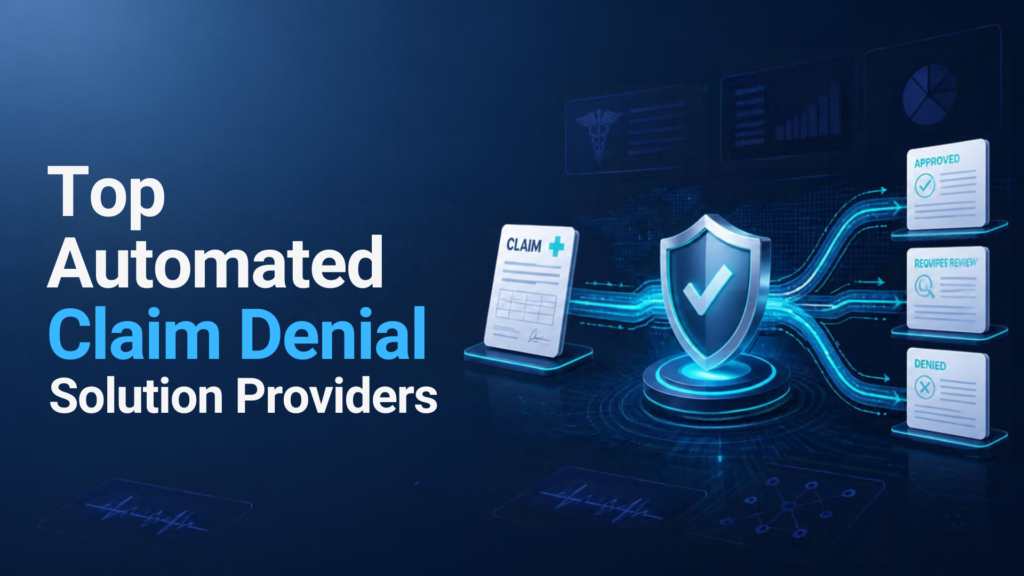
Claims denials occur due to various reasons, including eligibility issues, incorrect coding, documentation errors, authorization problems, duplicate claims, or specific payer guidelines. The denial management process traditionally involves analyzing denied claims, communicating with payers or patients, correcting documentation, and resubmitting claims. Intelligent automation solutions can connect billing systems, payer portals, practice management systems, document management tools, and other applications to proactively detect and resolve issues before they arrive at payers.
Modern automation solutions also help transform Automated claims management from reactive to preventive denial management. For instance, robotic process automation (RPA) bots can check insurance details, documents, coding, and other elements for accuracy, classify denial reasons, and route to the appropriate team for resolution.
Top Companies Providing Claim Denial Solutions
1. Ramam Tech
Ramam Tech specializes in RPA development, AI automation, and healthcare-specific solutions. The company’s automation solutions address various healthcare and billing needs, including processing claims and payments. Moreover, as an RPA development company, Ramam Tech can deliver end-to-end automation solutions that integrate with the organization’s ERP, CRM, healthcare, or cloud systems. Notably, the company’s extensive body of published works on medical billing automation covers automated claim submission, payment processing, denial analysis and correction, and resubmission.
As an RPA development company, Ramam Tech offers custom automation solutions rather than prepackaged applications. In addition to healthcare automation solutions, the company offers Excel Automation for Businesses and related services, including testing and API automation.
2. UiPath
UiPath’s healthcare automation solutions focus on claims and denial management, including pre-approval validation, root-cause analysis, appeal drafting, and correction. The company’s intelligent automation solutions combine robots, artificial intelligence, and human collaboration to address various revenue-cycle needs.
3. Automation Anywhere
Automation Anywhere offers healthcare agentic automation solutions that address eligibility, coding validation, prior authorizations, claim scrubbing, denial resolution, and appeal tracking. The company’s automation solutions combine AI agents and existing healthcare systems and involve human collaboration.
4. SS&C Blue Prism
SS&C Blue Prism offers end-to-end healthcare automation solutions, including revenue-cycle management, claim processing, medical billing, and related administrative tasks. The company’s solutions combine RPA, AI agents, orchestration, and governance.
5. Waystar
Waystar’s denial and appeal management solutions involve utilizing robots and artificial intelligence to triage, package, track, and analyze denied claims. Apart from core denial and appeal management solutions, the company also offers specific payer workflows, analytics, and system integrations.
6. FinThrive
FinThrive offers Denials Prevention Manager, an AI application that helps identify high-risk denials before claim submission. According to the company’s claims, the application utilizes AI to analyze payers’ behaviors and analyze line-item denial risks.
7. R1
R1 offers AI-assisted denial management solutions that combine automated and assisted clinical and operational workflows. The company’s solution helps throughout the denial lifecycle, from detection, appeal preparation, validation, submission, and follow-up.
8. CitiusTech
CitiusTech specializes in AI-powered healthcare process automation, intelligence augmentation, and operational process reengineering. The company’s solutions focus on data integration and operational automation, including healthcare claim processing.
9. Vitraya Technologies
Vitraya Technologies specializes in AI-powered adjudication solutions for automating claims processing. The company offers end-to-end automated adjudication solutions for straight-through processing in the insurance and healthcare industries.
Common Features of Automated Claim Denial Software
Modern Intelligent automation solutions usually involve a combination of the following capabilities:
- Automated eligibility and coverage verification
- Claim validation, error detection, and error correction
- Coding and documentation validation
- Denial categorization and analysis
- Appeal drafting, validation, submission, and follow-up
- Payer-specific routing and workflows
- Claim status tracking, automated follow-ups, and notifications
- Analytics and denial management dashboards
- System integrations, including EHR, billing, ERP, and payer systems
- Excel Automation for Businesses for denial reporting, reconciliation, management, and similar purposes
How Automated Claim Denial Solutions Work
How exactly do automated claim denial solutions work? In general, such solutions start by retrieving data from various systems, including clearinghouses, billing applications, practice management systems, EHRs, payer portals, documents, and other sources. Then, the application analyzes this data using predefined instructions or artificial intelligence to determine if any abnormalities or errors have occurred.
Depending on the solution’s design and functionality, it may flag or notify humans about potential issues before the claim is submitted to a payer. Once a denial occurs, the application can read the denial code and probable cause, gather relevant documents and information, and route the case to the appropriate employee for resolution. Some applications can even generate an appeal, which a human can review and approve before submission.
Benefits of Automated Claim Denial Management
How exactly can automated claim denial solutions benefit organizations? First and foremost, such solutions can help reduce denials and the associated losses due to claim rejections or delays. This advantage arises from the fact that robotic process automation solutions can check eligibility, coding, documentation, and other elements for accuracy before claim submission.
In addition, Intelligent automation solutions reduce the time spent on repetitive, rule-based tasks, such as eligibility verification, claim status checks, or follow-up activities. Instead of doing these activities manually and incurring time expenses, robotic process automation (RPA) bots or artificial intelligence can handle these tasks with minimal human supervision.
Additional advantages of automated denial management solutions include improved productivity, increased accuracy, enhanced analytics and reporting, faster appeal preparation, better tracking of appeal deadlines, more consistent and standardized processes, and reduced administrative burden and expenses.
An RPA development company can create a solution that integrates with existing applications, which is usually preferable to replacing legacy systems. This advantage is especially relevant for healthcare providers that have to work with multiple systems and applications for billing or other revenue-cycle management activities.
Challenges In Claim Denial Automation
Despite the benefits of robotic process automation and Intelligent automation solutions, such technologies are not perfect and introduce some challenges. First and foremost, automation solutions are only as good as their programming and training. If the application receives poor-quality data or is not properly programmed and trained, it will produce poor results.
Privacy, security, audit control, and human clinical and administrative expertise are equally important, particularly in cases that involve documentation and analysis of medical records. A hyper automation company in usa may combine RPA, AI, and business process management to help medical organizations optimize denial management and other revenue-cycle processes. However, such solutions involve complex implementation and utilization.
Software qa automation services play an equally crucial role by helping ensure that applications function correctly and do not introduce additional errors. In general, software quality assurance services help reduce risks associated with automation by ensuring that robots, artificial intelligence, and other technologies work as intended.
Future Of Automated Claim Denial Solutions
What are the future trends in automated claim denial solutions? One of the emerging trends in healthcare automation is the application of generative AI and agentic automation in claim denial prevention and resolution. Additionally, more and more applications are utilizing predictive analytics to identify patterns that lead to denials. Some solutions also utilize real-time eligibility verification to reduce the risks of claim denial during submission.
In general, modern applications are moving away from addressing single cases and focusing more on analyzing large amounts of data to identify patterns and problems within a healthcare organization’s revenue-cycle management activities. At the same time, AI agents are being programmed to collaborate and perform more complex tasks. This advancement allows robotic process automation solutions to handle more sophisticated activities, including various elements of revenue-cycle management.
Conclusion
For medical billing departments, RPA for medical billing is expected to evolve from automating repetitive, rule-based tasks into orchestrating multiple processes through robotic process automation and artificial intelligence. Top medical billing automation companies are expected to combine various technologies, including RPA, AI, analytics, and business process management, to deliver intelligent automation solutions that optimize the revenue cycle.