
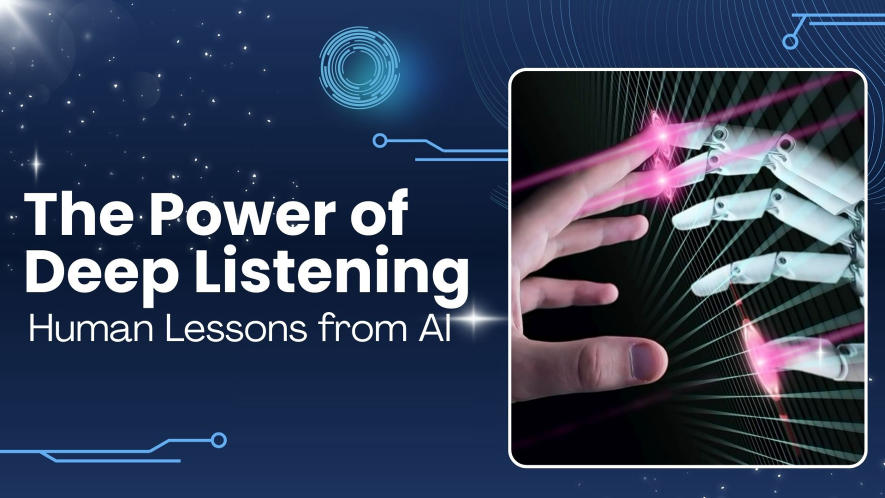
We live in a lightning-fast digital age, and most forms of conversation take place quickly now: emails, chats, calls, voice notes — and, as ever more often with the rest of these, automated replies. We listen to words all the time, but we don’t always hear them. That is where the idea of deep listening comes into play.
Interestingly, as artificial intelligence advances in surprising ways — particularly through AI chatbot services for businesses — we’re learning some unanticipated lessons about how humans can be better listeners. AI trains computers to process patterns, intent, tone and sentiment at scale. Machines obviously can’t feel, not yet anyway, but by listening in this structured way they have begun to hear something that humans often don’t amid the everyday noise.
This article provides an overview of what deep listening means, why it is important for personal and professional life, what AI “hears” in contrast to humans , with the way they listen and how businesses can learn from both advantages, not only of chatbots vs human agents, but also use them to improve communications.
What Is Deep Listening and How Does Deep Listening Differ From Regular Listening?
When most people think of listening, the concept is just hearing someone talk. Hearing is not listening in your mindlympics.
Regular listening is passive. You listen to the words, but your mind might already be formulating a reply or multi-tasking or miles away with another thought.
In contrast, deep listening is intentional and active. It involves:
- Listening attentively to the speaker
- Understanding emotions, not just words
- Observing tone, pauses, and emphasis
- Responding thoughtfully instead of reacting quickly
Deep listening is feeling, not just hearing.
In business research, deep listening also refers to how businesses may analyse unstructured data — such as customer comments, chat and feedback responses — for real insight versus high-level metrics. For instance, groups using AI-based deep listening can work through hundreds of pages of customer feedback in a matter of days brought down from months and discover patterns that people just don’t perceive.
Why Deep Listening Is Important in Personal and Professional Situations
In Personal Life
Deep listening strengthens relationships. When people actually feel heard, trust is built. The conversations that do happen are safer, more honest and more daring. Instead of confusion, you gain clarity. Instead of defensiveness, you get compassion.
And studies in psychology show that when people feel heard, they gain greater self-awareness and emotional regulation, which improves not only mental health but society as a whole.
In Professional Life
At work, deep listening affects performance and culture head-on.
Employees who feel heard are:
- More engaged
- More collaborative
- More loyal to their organisation
Gallup research shows that engaged teams — where leaders listen well — are up to 20% more productive and profitable. Bad listening, in contrast, produces rework, conflict and lost opportunities.
That’s why businesses will continue to throw their collective weight behind AI chatbot services for businesses— not to replace human listening, but rather to enable communication at scale and ensure no customer or employee’s voice goes unheard.
How Deep Listening Improves Workplace Communication
Deep listening changes the nature of workplace communication in these five powerful ways:
1. Reduces Misunderstandings
When leaders and teams hear one another, they have clearer instructions, their expectations are in line with each other’s and assumptions are minimised.
2. Encourages Open Feedback
People are more likely to speak up about their ideas and worries if they believe those concerns will be heard. This improves innovation and problem-solving.
3. Strengthens Leadership
Great leaders are remembered not so much for how they talk, but for how they listen. This sort of deep listening results in psychological safety, and that affects team performance.
4. Supports Hybrid and Remote Work
In digital workplaces sans tone and body language, careful attention to context is key. Studies on digital communication show that empathy and attentiveness significantly improve outcomes in remote environments.
What AI “Hears” vs What Humans Listen To
What AI Hears
AI systems “hear” through:
- Speech-to-text conversion
- Natural language processing (NLP)
- Keyword extraction
- Sentiment analysis
AI doesn’t listen emotionally. It processes patterns. But this pattern-driven listening is very powerful at scale.
For example, conversational AI systems can sift through millions of chat interactions to diagnose:
- Repeated customer pain points
- Sentiment trends
- Intent patterns
- Service gaps
That’s why the top AI chatbot companies can help businesses get under the skin of their customers faster and more accurately than manual approaches ever could.
What Humans Listen To
Humans listen to:
- Tone and emotion
- Context and history
- Unspoken signals
- Personal meaning
The way humans listen is intuitive and emotionally profound — something AI has long struggled to replicate. An AI has been proven to think like a human when it comes to auditory comprehension. Research finds that people are superior when they have to listen, understand and interpret in the presence of background noise and other disturbances.
What AI Can Teach Humans About Deep Listening
Though AI can’t replace human empathy, it offers valuable lessons in listening:
1. Listen Without Interrupting
AI systems don’t interrupt. Humans often do. “Deep listening means patience — it’s letting someone finish before you talk.”
2. Focus on Patterns, Not Just Moments
AI identifies recurring themes. Humans can follow suit by noticing repeated worries or feelings, rather than reacting to individual statements.
3. Ask Clarifying Questions
Great AI models will ask follow-up questions to narrow down understanding. People should do the same thing except they reach into their brains and assume intention.
4. Separate Emotion from Reaction
AI processes emotion neutrally. People can learn to notice feelings without having them overwhelm; this is an essential skill for managing conflict.
Deep Listening as a Human Skill
Deep listening is not something that happens automatically — it’s a capacity that grows with practice.
It requires:
- Attention control
- Emotional intelligence
- Curiosity
- Self-awareness
And when people train their minds to listen, they frequently realize that they know themselves better. To listen reflectively is to make people see their own biases, emotional triggers, and assumptions.
This self-knowledge is good for leadership, decision-making and emotional intelligence — things no algorithm can replace entirely.
Common Barriers to Practising Deep Listening
Deep listening is as helpful as it is rare. Some common barriers include:
1. Distractions
Phones, alerts and multitasking interfere with listening quality. Research suggests that people only remember, on average, about a 25% of what they hear in everyday conversations because they’re preoccupied.
2. Bias and Assumptions
You cannot stop pre-judging what someone will say, or you’ll never hear it.
3. Emotional Reactivity
Strong feelings can impede listening and start a conversation boiling toward argument.
4. Over-Reliance on Technology
Although AI chatbot services for businesses allow to manage the volume of communication, only relying on automation instead of integrating human empathy can erode relationships.
How Deep Listening Improves Self-Awareness
Deep listening is not only a service to others, but it’s also something that helps the listener.
When you listen deeply:
- You recognise emotional patterns
- You reflect before responding
- You are addressing your own bias
- You improve emotional regulation
Psychological studies find that when people listen, they feel clarified about their own thoughts and emotions — and even listen better if first heard out themselves.
This is why deep listening is so closely tied to mindfulness, the development of leadership and emotional intelligence.
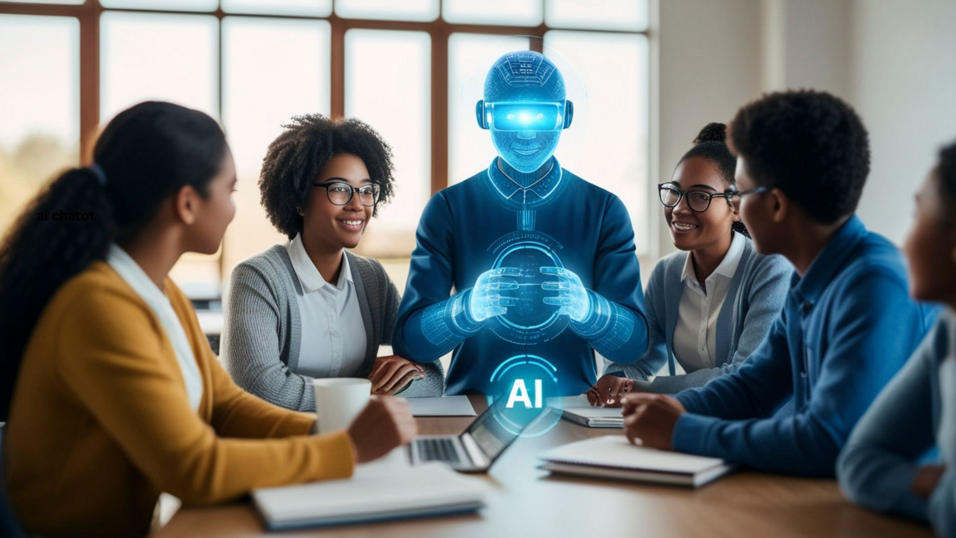
AI Chatbots vs Human Agents: Listening at Scale vs Listening with Empathy
This brings us to an important comparison: AI Chatbots vs Human Agents.
Where AI Chatbots Excel
AI chatbots are excellent at:
- Handling high volumes of queries
- Providing instant responses
- Offering 24/7 availability
- Reducing customer support costs
Companies leveraging AI chatbots are experiencing up to a 30% saving in customer service costs.
Where Human Agents Still Win
Human agents outperform AI in:
- Emotional understanding
- Complex problem-solving
- Relationship-based interactions
It is widely reported that emotionally sensitive issues are least satisfied by customers through machine contact.
Emotionally Intelligent Chatbots and Agentic AI Development Services
In order to bridge this gap, organisations are spending on Emotionally Intelligent Chatbot offerings. These systems are based on sentiment analysis and contextual notice, so they act more naturally — but still feel rather than sense empathy.
In addition, Agentic AI chatbot development services are enabling AI to do more than respond. Agentic AI can:
- Take autonomous actions
- Execute workflows
- Remember context
- Escalate intelligently to humans
And these systems don’t replace so much as support human deep listening, by managing routine interactions and allowing humans to concentrate on emotionally dense conversations.
What A.I. Still Can’t Do: The Limits of Machine Listening
While AI chatbot services for businesses have continued to evolve at great speed, artificial intelligence has its own weaknesses, one of which is that it does not listen deeply. The digital mind can analyse language, perceive sentiment and respond nimbly — but listening is about more than mere technical accuracy.
1. AI cannot truly Understand Human Emotion
AI-based systems can recognisee emotional indicators including positive, negative or neutral sentiment. Some more advanced ones can even pick up on frustration, urgency and happiness in speech or text. But that is pattern recognition, not emotional understanding.
An AI doesn’t care if a customer is angry. It does not feel empathy — it fakes it.
Some studies in conversational AI empathy report that, whilst responses generated by AI may enhance perceived quality of conversation people still experience feeling more empathised with when the interaction is with humans and especially so in emotionally sensitive topics.
And this is an important distinction to keep in mind when comparing AI Chatbot vs Human Agents. There is no substitute for what humans can do, which is read between the lines, pick up on hesitation and alter their tone of voice or pitch without even being aware they are doing it — something AI still cannot authentically achieve.
2. AI Struggles With Deep Context and Long-Term Memory
Human listeners have a memory for past conversations, emotional history and personal nuances. Artificial Intelligence (AI) systems tend to consider interactions between agents as isolated occurrences unless specifically engineered with advanced memory mechanisms.
Even with today’s Agentic AI development services, where AI can complete multi-step tasks and contextualize information-long-viewing human complexity remains hard to understand.
For example:
- A human representative in charge of customer service recalls a complaint from the past
- AI recalls known data points and never life experience
It’s this limitation that makes even the top AI chatbot companies to suggest a hybrid approach—with human agents taking over for context and emotional depth when needed, and letting AI do the rest.
3. AI has No Morality and no Autonomy
Very often, I think a deep listening involves ethical judgment — knowing when not to speak, how much to say or if and when to escalate an issue. These are value based, culture sensitive and emotionally intelligent choices.
AI is based on preset limits and training data. It doesn’t quite comprehend moral grayness, or emotional shade, in tricky conversations like:
- Mental health discussions
- Conflict resolution
- Personal loss
- High-stakes business negotiations
This is one of the reasons that AI is best thought of as an assistive listener, rather than a decision maker.
4. AI Cannot Replace Human Presence
One of the most potent features of deep listening is presence — the sense that someone is here with you.
Research has found that most people respond better to their queries when they think they’re talking to a human, even if an AI system gives technically accurate responses to their respective queries.
Therefore, Presence builds trust. Trust builds relationships. And relationships remain a human territory.
Why Businesses Need Both AI Listening and Human Deep Listening
Today’s organizations don’t have to pick between AI and humans; they need both.
How AI Supercharges Listening at Scale
AI helps businesses:
- Capture every customer voice
- Analyze large volumes of conversations
- Identify trends and recurring issues
- Respond instantly to routine queries
AI powered conversational intelligence platforms, for instance, can help businesses listen to millions of customer interactions at once — tasks humans alone simply couldn’t manage.
That’s why AI chatbot services for businesses are so important: in order to scale as rapidly and efficiently as possible.
How complete the Listening Loop
Humans bring:
- Emotional intelligence
- Judgment and ethics
- Creativity and intuition
- Relationship-building skills
When AI takes care of the repetitive communication, human agents have time and mental bandwidth to engage in authentic deep listening — particularly important during high-stakes or emotionally charged interactions.
This balance is where Emotionally Intelligent Chatbot systems excel in conjunction with human empathy.
Future Deep Listening: Human + AI collaboration
The future of listening is not machines replacing humans — it’s a collaboration.
Emerging Agentic AI development services are allowing AI to:
- Understand intent more accurately
- Maintain conversation context
- Do it for the customers
- Know when to go to the humans.
In the meantime, businesses are more and more teaching their own employees to:
- Active listening
- Empathy-based communication
- Emotional intelligence
- Reflective feedback
This integrated scheme generates communications that are effective and human-centric.
Conclusion: Moving Beyond Hearing
Deep listening is a skill — and an advantage in strategy.
AI basically offers us a picture of what structured, focused listening at scale looks like. Through people, we have learned what emotions and feelings along with meaningful listening are. Neither gets the job done on its own.
With AI chatbot services for businesses, there is no voice left unattended. With human deep listening, they make sure all voices are heard.
The future of communication is balancing:
- AI deals with scale, speed and structure
- People give it meaning, empathy and the capacity to understand
By pairing the accuracy of AI with the humanity of a person, we can go beyond listening — toward understanding, clarity and impact.
FAQs
What is deep listening?
How does deep listening differ from normal listening?
Can AI chatbots demonstrate human-like deep listening?
Why deep listening matters for businesses
Can AI chatbots listen better than human agents?