
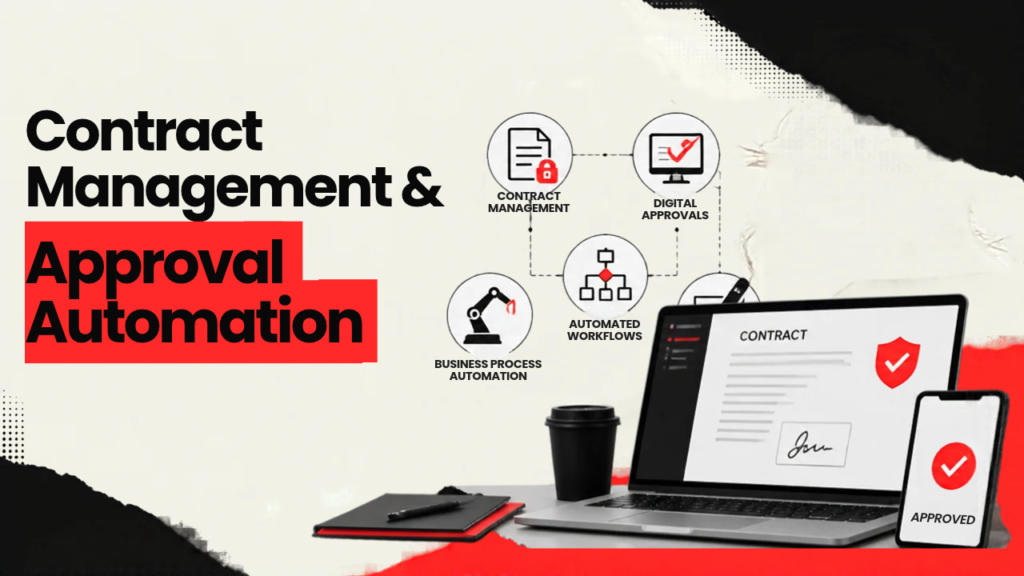
The process of managing business contracts involves numerous functions such as creating documents, reviewing by counsel, approving internally, signing, and tracking renewals. If employees perform all of these processes manually, even the simplest agreement may require multiple days to process. In addition to potential delays in processing times, manual processing can negatively impact employee productivity and relationship management with other companies.
The reason why many companies have begun to adopt Process Automation Services for simplifying the way they manage their contracts and digital approval processes is that by using a combination of workflow automation, artificial intelligence (AI), electronic signature technology, and centralizing all of their documents within a single system, organizations are able to eliminate redundant tasks and increase their overall operational efficiencies.
The business implications are substantial. Based on the 2025 Deloitte & DocuSign Digital Agreement Management Survey (which collected responses from over 1,400 business leaders), 77 percent of leaders in top performing companies attribute their ability to improve financial performance to having well-managed agreements.
So what is the best way for organizations to automate their contract management processes while maintaining high levels of accuracy, security and accountability? In this section, we will look at how companies can use technology, benefits, and best practices to begin automating their contract management processes.
Understanding Contract Management Automation
Contract management automation utilizes digital technology to manage agreements from start to finish. These technologies include: creating contracts, negotiating contracts, reviewing contracts, approving contracts, signing contracts, storing contracts, and managing renewals of contracts.
Employees have managed their activity with email, spread sheets and other separate document management applications. The issue that this creates is outdated contract versions, missing information, delay in approval process, and missing deadline dates.
Automation connects these activities through a centralized platform.
For example, if a sales person wants to create a new customer agreement, the system can use an approved template to produce the document, pull the customer’s data from the company’s CRM, and submit the completed agreement to both the legal department and the finance department for their approval. After the agreement has been approved, it will move into an electronically signed state and be saved within a searchable repository.
Modern Process automation services are designed to link contract workflows with existing business applications. This helps reduce the need for manual data entry and improves the ability of different departments to coordinate with one another.
Importance of Digital Approvals in Business
Digital approvals enable employees to view, approve and monitor their documents digitally rather than using paper based processes or long email exchanges.
For example, if a firm buys machinery from a first-time vendor, there could be an approval process that involves departments such as Procurement, Finance, Legal, and Senior Management. If this process is manual (i.e., not automated), employees would need to manually route the paperwork to each of those departments, and then follow-up with each department individually.
Digital approval automation makes the process easier with predefined rules that allow you to locate the correct people to approve.
How do automated contract approval workflows work?
Automated Approval Workflows generally follow these steps:
- Request Submission: The employee fills out an online form that includes information about the contract, business requirements and estimated costs.
- Document creation: The system generates an agreement using an approved template.
- The document will be automatically routed to the proper departments based on the type of contract or agreement, the cost/value of the contract, and the degree of risk involved in the contract.
- Notifications: Approvers receive alerts when their review is required.
- Authorized employees can either accept, reject, or suggest modifications to the material.
- Electronic signing: The approved agreement is sent to the required signatories.
The signed agreement will be stored in a central database to provide an available resource for future reference.
Businesses may set up a process of approval sequences, parallel reviews of requests, conditional request routing, and automatic escalation of past-due requests.
For example, a typical non-disclosure agreement will only require the approval of a department, but a higher-value supplier contract will likely require further approval from both the legal and financial departments.
Key Features of Contract Management Automation
Modern contract management platforms incorporate various technological elements to make managing a business easier.
1. Automated contract creation
Businesses can create agreements by using pre-existing templates and approved clauses. This will automatically populate the agreement with relevant customer, supplier, and financial data from other business systems, which will reduce the need to prepare documents repeatedly.
2. AI-powered contract review
Artificial Intelligence (AI) and Natural Language Processing (NLP) are capable of identifying the most important clauses within a contract, as well as extracting payment provisions, creating summaries of the agreement, and highlighting any unconventional provisions. These findings can assist lawyers in determining which contracts require further review.
3. Automated approval routing
Employees are assigned contracts according to pre-determined rules that are established through organization policy. Delays in processing can be avoided with notifications and escalating procedures.
4. Centralized document management
A database that has a function to search for executed agreements will store the agreement versions, access to the agreements, and other pertinent contract details. This enables employees to easily access files without having to look through numerous folders.
5. Obligation and renewal tracking
The system is designed to keep track of payment due dates, service level agreements, expiration dates, and renewal terms. Reminders are generated automatically to prompt contract owners to take action on critical dates.
6. Business system integration
An API connects a company’s contract management platform to its customer relationship management (CRM), enterprise resource planning (ERP), human resources (HR), accounting and purchasing/procurement systems. Additionally, an experienced RPA solution provider may be able to assist in automating manual processes with older applications that do not have contemporary integration options.
Benefits of Automating Contract Management
Process automation services provide a way for organizations to increase their efficiency through process improvements in areas such as Legal, Finance, Sales, Procurement, and Operations.
Implementing process automation services will help increase efficiencies within the legal, finance, sales, procurement and operations departments.
Faster approvals: Auto-routing and notification can help decrease the amount of time that lapses between departments during the approval process. Remote employee access to the agreement allows for reviews to take place on-line as opposed to having to physically send documents back and forth.
Less administration mistakes: Use templates and format which are standardized along with automation of data entry, email and validations of information will decrease the amount of information that is missing and not limited to incorrect detail, or duplicated records.
Business’ ability to stay compliant is enhanced by using approval limits, permission based on roles, and audit trails to assist in maintaining the consistency of internal controls.
Automate to lower operational costs: By automating your processes, you will be able to reduce the amount of time spent on administrative tasks such as printing, scanning, document management, and following up on items.
Business visibility is improved: Management is able to see what contracts are currently being worked on (pending), when those contracts will need to be renewed (upcoming), how well the company does at getting its contracts approved (approval performance), and if it has any outstanding contractual commitments (contractual obligations) via central dashboards.
The use of Data Mining Expertise within organizations based in the United States will allow them to better evaluate structured contract data to determine spending habits, how well suppliers are performing, common contract terms, and possible financial risks.
The financial advantages can be taken into account. According to Deloitte’s 2026 AI Contract Lifecycle Management Survey (with over 1,100 participants), the average gain in efficiency for agreement workflow is 36 percent. Also, 72 percent of those surveyed indicated that there was an improvement in the accuracy of agreements. While these are survey results, and therefore cannot be guaranteed, they indicate that there is a possibility that using automated contracts will lead to similar increases in both productivity and quality.
Role of E-Signatures in Digital Approvals
Electronic signatures are a way to make signing contracts and other genuine types of agreements over the internet much simpler than traditional methods. Electronic signatures do not require you to print out your document, nor do they require you to sign it using a pen. This means that you just have to scan your signed document into your computer or physically mail it to someone else.
In most cases a typical process includes uploading an agreement that has been approved, identifying the individuals who are required to sign the agreement, issuing securely transmitted requests for signatures, obtaining those signatures from the appropriate parties, and creating an execution record.
In the U.S the Electronic Signatures in Global and National Commerce Act Electronic Signatures in Global and National Commerce (ESIGN) provides that a contract or signature may not be denied legal effect based on its being electronic. Many countries recognize electronic signatures as valid.
However, prior to using electronic execution for each type of document, businesses will need to determine if there are any specific transaction requirements, what is needed for identity verification, and which of the current laws may allow for exemptions.
Best Practices for Implementing Automation
The successful deployment of a business application requires more than just buying the software. A business must create defined processes, responsibilities, and security policies.
Automating a business process successfully takes good planning. A company needs to clearly define its processes and who is responsible for each step. Additionally, a company will need to implement appropriate security measures to ensure that the automated software functions correctly.
Companies who plan to use automation in their business should evaluate what they are doing currently. By evaluating how work is being done, a company will be able to determine where delays occur due to waiting on approval for something, as well as where some type of repetition is occurring. Additionally, companies will be able to see where there may be a problem with managing documents or where a compliance issue needs to be addressed.
Establish clear authorization levels: Establish clearly defined approval limits based upon contract type. Approval limits can vary depending upon contract value and risk level. Additionally, departmental needs may affect authorization limits. Establishing these limits will help ensure that the appropriate individuals review and approve each agreement.
Integrate current software applications: Link the automated process with customer relationship management (CRM) and enterprise resource planning (ERP) systems. The automation software must also function with human resources (HR) and accounting software. Automated processes can also be linked to purchase management systems. Automating these connections will reduce repetitive data entry and provide better control over managing data.
Train Employees: Employee training on how to submit a request for approval of an agreement, on how to review the terms of an agreement before signing, on how to approve and sign off on agreements, and on how to track compliance with contract terms.
Review Performance: Track the amount of time it takes to get approvals, how much it costs to process each contract, how many errors occur in the process, if renewals are processed correctly, and to what degree employees adopt the system.
Human review of all legal contracts is required by businesses as well as the review and approval process for those that are considered “high risk.” When using AI-generated contract recommendations, business owners need to verify that these recommendations align with what is contained in the original contract document.
Organizations can use these available automation technologies throughout their organization to automate other parts of the business. For example, organizations can utilize RPA in Digital Marketing to automate the process of generating reports on campaigns and entering data. Additionally, organizations can use some of the top test automation services to ensure the quality of their software.
Lastly, organizations can use Machine Learning Consulting Services to help them create intelligent document classification, extract information from documents, and provide predictive business analytics.
Future Trends in Contract Management Automation
As per the trend of new age ai driven technology, the future of how contracts are managed will be fundamentally based on more intelligence along with connected, and active systems.
In addition to being able to automate the process of contracting by coordinating request for contracts, obtaining templates, extracting relevant information from those templates, identifying potential risk areas, and tracking the status of approvals, there will continue to be significant decision making and authorization that remains within the scope of responsible humans.
Businesses can utilize their past contract data to assess where they are having delays in getting approvals on contracts, what problems exist with their suppliers, and which contracts may be up for renewal soon.
The number of employee questions about things like “which contracts expire next quarter” will increase, and employees will be able to find answers to these questions within their company’s approved contract repository.
Contract management platforms will integrate with other internal enterprise applications such as those used for finance, purchasing, customer relationship management (CRM) and human resources (HR), which creates a more seamless flow of information throughout an organization’s business processes.
With the advancement of these technologies, process automation services will continue to enable businesses to transition from simple document processing to more sophisticated contract life cycle management.
Conclusion
Automating your business’s contracting and approval processes through digital solutions will help lower the administrative burden on your staff, improve the accuracy of the process, enhance regulatory compliance, and increase efficiency when managing contracts. Through an integrated approach to contract lifecycle management (CLM) platforms, AI-based document analysis, automated approval routing, electronic signature capabilities, and enterprise-wide integrations, organizations can develop a unified contract lifecycle.
As a business owner, keep in mind that a successful implementation of the process requires the use of standard procedures, accurate data, safe technology, and proper human supervision. Machine learning consulting companies who create such a base will have the ability to enhance operations through increased efficiency, and at the same time maintain greater control over contract obligations and business risks.
FAQ
How much does contract management automation cost?
Can small businesses automate contract approvals?
Is automated contract management secure?
Can automation integrate with existing business software?
How long does it take to implement contract management automation?