
Search is undergoing one of the largest and most significant changes in its history.
Digital marketing in the past years used to focus on a single objective, which was ranking on Google. Keywords, backlinks, and SEO in the technical aspect were highly invested in by brands to ensure they got the first position in the result pages of the search engines. Yet nowadays such a model is being transformed quickly.
Users are no longer willing to scroll up and down multiple links before getting answers, but rather, demand instant and conversational answers. ChatGPT and Perplexity (also known as a new age search engine) are platforms that are really redefining the process of discovering, consuming, and trusting information.
Recently, some of the data and statistics indicate that ChatGPT alone processes 2.5 billion prompts per day, which really demonstrates how quickly users are moving towards AI-enabled search experiences. Meanwhile, the percentage of informational queries that AI search engines respond to is approximately 27 and it is only increasing every year.
More to the point, approximately 63% of such searches, conducted with the help of AI, are zero-clicks, i.e., the user finds what they require without visiting a webpage.
This changes everything:
No longer should visibility be considered about ranking on Google, but as being part of the answers provided by AI.
This change is particularly relevant to companies that provide AI chatbot development services, AI is no longer merely a tool, it is now the main interface between brands and users.
What AI SEO Means in the Age of ChatGPT and Perplexity
AI SEO is a novel field of digital marketing. It is commonly termed as:
- Generative Engine Optimisation (GEO)
- Answer Engine Optimisation (AEO)
The essence of AI SEO is about only one thing:
- Getting your brand suggested by AI.
Unlike traditional SEO, in which rankings and clicks are used to determine the success of the process, AI SEO depends on:
- Appearing in responses
- Being cited in suggestions
- Trustworthiness by AI models
This change is well explained in this AI search strategy whitepaper, where it is pointed out that businesses are no longer fighting over rankings but visibility in the AI-generated responses.
What is Generative Engine Optimisation (GEO)?
Generative Engine Optimisation (GEO) describes the act of genuinely optimising and structuring the content to allow AI solutions such as ChatGPT and Perplexity to:
- Understand it easily
- Relief on it as a fount
- Add it to the generated answers
GEO is not about keywords, as is the case with traditional SEO. It is about:
- Context
- Meaningn
- Authority
- Structurer
In simple terms:
- SEO assists you in ranking.
- GEO assists you in being recommended.
The working of AI systems is behind this change. They do not simply access information, they accomplish interpretation, summary and synthesis.
Studies indicate that the artificial intelligence search engines are very dependent on a variety of sources to provide one solution, as opposed to offering the user a list of options.
How AI Tools Decide Which Brands to Recommend
You must learn how AI SEO works in order to know how tools such as ChatGPT and Perplexity work. The system they apply is Retrieval-Augmented Generation (RAG).
This combines:
- Information retrieval
- Machine learning
- Natural language generation
The process is as follows in practice:
1. Understanding User Intent
AI does not simply look at keywords. It attempts to comprehend:
- The user wants what he desires.
- The background to the query.
- The anticipated nature of the response.
Considering the example, such a query as the best AI tools to use in business is viewed as a decision-making query, rather than an informational one.
2. Obtaining information by using a variety of sources
AI systems search a wide variety of sources, such as:
- Websites
- Blogs
- News platforms
- Forums
- Reviews
Interestingly, they tend to use third-party sources a lot as opposed to brand-owned content.
It has been proven that AI systems heavily favour earned media (external validation) as compared to direct brand messaging.
3. Assessing Trust and Authority
Upon content retrieval, AI analyses it depending on:
- Credibility
- Accuracy
- Depth
- Consistency
This is what is commonly called “algorithmic trust”.
This AI search report and benchmarks indicate that brands that build a consistent authority across platforms will be much more visible in AI-generated results.
4. Production of the Final Answer
Lastly, AI integrates the information provided by various sources and creates one answer.
This is the largest change that occurs:
- There is no longer a choice between options with users
- AI makes decisions on his behalf.
That is why the inclusion in the answer list is more important than being on a page.
Major Indicators that Mainly Impact AI Visibility (Authority, Mentions, Structure)
AI systems rely on a completely different set of signals compared to traditional search engines. Understanding these signals is critical for success.
1. Signals of Authority and Trust
One of the significant AI SEO factors is authority.
The AI models are more focused on content that shows:
- Expertise
- Accuracy
- Reliability
This is particularly crucial to industries such as:
- AI ML Consulting
- agentic ai consulting
- Enterprise technology services
Since AI systems are set to reduce the amount of misinformation, they prefer to have sources with visible expertise and credibility.
2. Brand References and Online Presence
Among the most unexpected things in AI SEO, it is that:
- Mentions matter more than backlinks.
Statistics indicate that mentions of the brand are strongly correlated with AI visibility rather than with conventional backlinks.
This implies that brands should emphasise:
- Media coverage
- Community discussions about the brand
- Reviews along with testimonials
- Industry mentions
These signals are considered to be evidence of the real-world relevance of AI systems.
3. Structure and Machine-readable Content
The structure of content is essential in AI SEO.
The systems of AI favour content that is:
- Clearly organised
- Easy to scan
- Logically structured
Studies indicate that factors such as:
- Headings
- Semantic HTML
- Structured formatting
Play a significant role in determining whether content is referenced in AI-generated responses.
Here, such technologies as RPA low code no code and RPA for SEO will come in handy, as they will allow automating the process of structuring and optimising content on a large scale.
4. Clarity and Depth of Content
AI favours content that is:
- Direct
- Informative
- Data-driven
This includes:
- Definitions
- Statistics
- Step-by-step explanations
As an example, the content that describes how to optimise ChatGPT to improve SEO and provide specific examples and data will be quoted more than something specifically marketing.
5. Freshness and Consistency
AI systems are constantly learning and updating their knowledge.
That means:
- New material gets priority
- Cross-platform consistency is important, too.
When your brand is closely coordinated across:
- Website
- Social media
- Third-party platforms
AI will be more inclined to believe and suggest it.
Why This Shift Matters for Businesses
AI SEO is not merely a technical shift, but a strategic one.
Traffic that is driven by AI acts in a very dissimilar manner:
- AI traffic conversion rates are much greater than those of traditional search.
- Users come with more purpose.
- Decision-making happens earlier
The industry statistics show that AI-based traffic has the power to transform 5 times more than conventional organic traffic.
This implies that there will be fewer visitors- yet better quality leads.
For businesses offering:
- AI chatbot development services
- AI automation solutions
- Enterprise consulting
This presents a huge opportunity to engage decision-ready users in AI conversations.With the rising adoption of AI, businesses are spending on AI chatbot development services and also selecting to hire remote Node. js developer in USA to provide scalable and efficient backend infrastructure.
The Bigger Picture: SEO vs AI Search Engines
The distinction between standard SEO and AI SEO is not slight- it is fundamental.
Traditional SEO is concerned with:
- Ranking pages
- Driving clicks
- Optimizing keywords
AI SEO is about:
- Earning trust
- Providing clarity
- Being the most excellent response.
This change is elaborated in the present report on AI SEO statistics, which illuminates the fact that AI systems rank more on context, authority and mentions than on the conventional ranking factors.
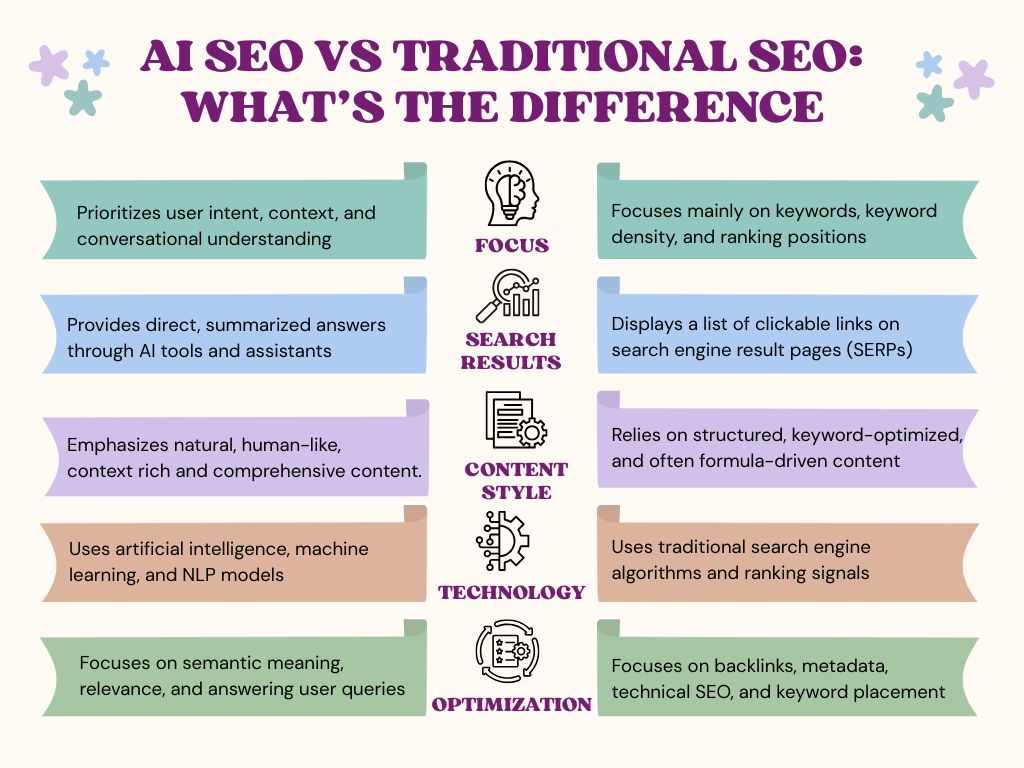
Then, How is AI SEO Different from Traditional SEO?
The main difference can be highlighted and classified in three major ways. These are as follows:
1. Intent Over Keywords
AI comprehends, not only search words.
2. Authority Over Backlinks
The number of links is irrelevant compared to trust signals.
3. Inclusion Over Ranking
Success = to have been in the solution.
This transformation is already coming to transform the digital landscape- and we are just at the beginning.
How Brands Are Optimising for AI-Driven Discovery
With AI search continuing to innovate, progressive brands are not waiting anymore, they are busy updating their strategies to remain visible in AI-driven responses.
The major distinction now is merely:
- You are not only optimising for users
- You are maximising towards AI systems that influence users
It has resulted in the rise of entirely new optimisation models, a mixture of conventional SEO, AI knowledge, and automation.
1. Generating AI-First, Context-Rich Content
The most winning brands are moving towards context-based content rather than heavily loaded content with keywords.
They are also not writing to the search engines, but to:
- Intent
- Clarity
- Depth
This implies that content should:
- Answer real questions
- Provide complete insights
- Include structured explanations
As an example, companies that provide ai chatbot development services now post:
- Use-case specific guides
- Industry-focused solutions
- Data-backed comparisons
This form of content works better as AI systems like detailed and self-sufficient answers.
The results of this AI content optimization study indicate that long-form, well-structured content is much more likely to be cited in AI-generated responses.
2. Content Organization to make it machine readable
Content structure is one of the most significant elements of ChatGPT SEO optimization. AI models do not read content like human beings, but rather parsing it. This implies that structure has a direct influence on visibility.
The most effective content mainly incorporates:
- With proper headings (H1, H2, H3)
- Short paragraphs
- Bullet points
- FAQs
- Tables and summaries
This is in line with this technical SEO and AI readability guide that argues that structured machine-readable content is important.
The brands are also utilizing:
- Schema markup
- Semantic HTML
- Internal linking
To simplify their content to the AI systems.
RPA of SEO and rpa low code no code tools come into play here to assist in automating:
- Content structuring
- Metadata optimization
- Data consistency
3. Building authority on Multiple Platforms
AI is not based on a single source.
Rather, it creates a comprehensive perception of your brand by examining:
- Website content
- Media mentions
- Reviews
- Community discussions
This implies that the brands have to go beyond their websites and establish presence in:
- News platforms
- Industry blogs
- Forums like Reddit
- Social media channels
This multi-platform authority report states that AI systems recommend brands with a high cross-platform visibility much more often.
This is why:
- PR
- Thought leadership
- Community engagements
Are emerging key components of AI SEO strategies.
4. Leveraging AI and Automation for Scale
AI SEO is not merely a strategy but also execution on a scale.
It is being used more often by brands:
- AI content tools
- Automation workflows
- Data analytics platforms
To:
- Create quality content at a quicker rate
- Optimize existing pages
- Track AI visibility
Technologies like:
- agentic ai consulting
- ai ml consulting
Do help businesses develop smart systems that:
- Continuously optimize content
- Analyze AI behavior
- Improve discoverability
Automation tools powered by RPA for SEO also allow brands to:
- Monitor mentions
- Track citations
- Update outdated content
This forms an endless optimization process, which is essential in an AI-first world.
5. Conversational Search Optimization
AI search is essentially conversational.
Users are asking such questions as:
- Which is the best AI tool for small businesses?
- What does AI SEO work?
Rather than entering brief keywords.
To adapt, brands are:
- Using conversation as a style of writing.
- Incorporation of natural language queries.
- Adding FAQ sections
This strategy enhances the following:
- SEO rankings
- AI visibility
And directly serves the questions such as:
- future of SEO with AI
- SEO vs AI search engines
Due to the fact that AI systems are developed to be similar to natural human language.
Challenges of Ranking in AI-Based Recommendation Systems
1. Lack of Transparency
The fact that AI systems are black boxes is one of the largest challenges.
Contrary to Google, where the factors of ranking are somewhat well-known, AI models do not describe:
- The reason as to why a brand was chosen.
- Why should not have been noticed.
This complicates and makes optimization more experimental.
2. Decrease in Click-Based Traffic
Answers created by AI minimize the use of websites.
Research shows that:
- A huge proportion of AI queries lead to zero-clicks.
This can also be understood in this analysis of AI search behavior, which emphasizes how users are becoming more and more dependent on AI-generated summaries, rather than scrolling through numerous pages.
This makes brands reconsider success measures:
- From Clicks → to visibility
- From traffic → to influence
3. Content Saturation and Competition
Thousands of sources are drawn to AI systems.
This means:
- The level of competition is more than ever
- The most authoritative and obvious content is chosen only
Even minute variations in:
- Structure
- Clarity
- Depth
Is able to decide on whether your content is featured or not.
4. Misinformation and Bias Risk
AI systems are not flawless.
They can:
- Misinterpret content
- Prioritize incorrect sources
- Judgmental tendencies in data
This poses threats to brands, particularly competitive markets such as:
- AI services
- Consulting
- Technology
In order to overcome this, the brands should concentrate on:
- Accuracy
- Transparency
- Credibility
5. Developing Algorithms and Standards
The search using AI is still developing.
What would work today may not work tomorrow.
New developments in:
- Large Language Models
- Search algorithms
- AI interfaces
Are continually redefining optimization strategies.
This explains why companies are spending a lot in:
- agentic ai consulting
- Advanced AI SEO frameworks
Will Google SEO Still Matter in the Age of ChatGPT?
This is a question, which is most frequent.
In a word:
=> Yes, but it is altering its role.
Google remains a dominating search engine, and traditional SEO still performs:
- Traffic
- Brand awareness
- Authority
But Google is changing itself.
With features like:
- AI Overviews
- Generative search experiences
Google is trending towards similar models as ChatGPT and Perplexity.
This Google AI search update overview states that a search is getting an AI-generated summary as a fundamental part of the search.
The New Reality: Hybrid SEO Strategy
It is not a matter of either SEO or AI in the future.
It is about putting together the two:
- Established SEO → Develops base.
- AI SEO → Drives recommendations
The combination of these results in a comprehensive visibility strategy.
The Future of SEO in an AI-First Search World
SEO is already being determined by its future and it is much different than before.
1. Search Becomes Conversational
Users will more and more communicate with:
- AI assistants
- Voice interfaces
- Chat-based search
This will necessitate optimization of natural language.
2. Visibility Replaces Ranking
Success will no longer be determined by:
- Position on a page
But by:
- Answers in AI presences
3. Authority Becomes the Primary Currency
Brands that:
- Build trust
- Demonstrate expertise
- Maintain consistency
Will take over AI discovery.
4. AI Becomes the First Touchpoint
To a large number of users, AI will be the initial experience with a brand.
This is more so in business which deals with:
- AI chatbot development service
- AI consulting
- Automation solutions
5. Continuous Optimization Will Be Essential
- AI SEO is not a single project.
It requires:
- Constant updates
- Performance tracking
- Strategy refinement
Final Thoughts
AI SEO is not merely a trend that everyone needs to focus on, but it is a fundamental and dynamic change in the way the internet functions.
We are moving from:
- Search engines → Answer engines.
- Rankings → Recommendations
- Traffic → Trust
To businesses, this provides:
- Challenges
- Opportunities
The early adapters will have a big edge.
By focusing on:
- Authority
- Structured content
- Multi-platform presence
- AI-driven strategies
The brands are given an opportunity to be continuously recommended by AI systems.
And in this new world:
It is not enough to be visible anymore
You must be the solution that AI decides to provide
FAQs
What is meaning of AI SEO?
What is ChatGPT SEO optimization?
What is the main difference between AI SEO and Traditional SEO
Are Backlinks Still Important in AI SEO?
How AI is shaping the future of SEO?