
Here’s the truth no founder wants to hear:
Building the app isn’t expensive.
Building the wrong app is.
And in 2025, users don’t download without thinking, don’t wait for onboarding, and uninstall anything that wastes their time.
So before you hire a mobile app development company, before you speak to an iOS app development services team, and before you invest in any custom software development services.
You validate because validation is the only cheap part of the entire journey.
Grab a coffee.
Let’s go step-by-step.
What Is App Idea Validation?
App idea validation is the process of proving that your app solves a real problem for real users before spending money on development.
The fastest way to kill a bad idea?
Validate it early.
The fastest way to scale a good idea?
Validate it early.
This guide shows you the cheapest way to do both.
Why Validation Matters in 2025
People don’t download experimental apps.
They download solutions.
And the app stores are brutal:
- 99% of apps die within 12 months
- Average uninstall time = 3 days
- People expect value within 30 seconds
So the goal is simple:
Find out if people want your app before you build it.
Not after.
Not during.
Before.
Step 1: Validate the Problem, Not the App
This is where most founders fail.
They fall in love with the idea. But users fall in love only with solutions.
Definition:
Problem validation means checking the pain point before testing the product.
The basic principle here is very straightforward:
An app will not have any importance if the issue it seeks to solve is not a significant one.
(Free & Quick) Method to Validate the Problem:
Hold a conversation with 10–20 potential end-users
Inquire:
- “What is the most challenging aspect of ___?”
- “How are you currently handling it?”
- “What annoys you the most?”
- “Are you willing to pay for a better solution?”
Assess actions rather than thoughts
Look at:
- Reddit discussions
- App Store ratings and comments
- Google Trends
- TikTok hashtags
- Quora queries
Detect trends such as:
- Grievances
- Awaited functionalities
- Emotional tension
- Frustrations known to users
If there are already users looking for solutions, then your idea is worth the risk.
Competitor Insight = Validation
The existence of similar apps is a sign of a good market.
Your task now is to beat them by being better, faster, and simpler.
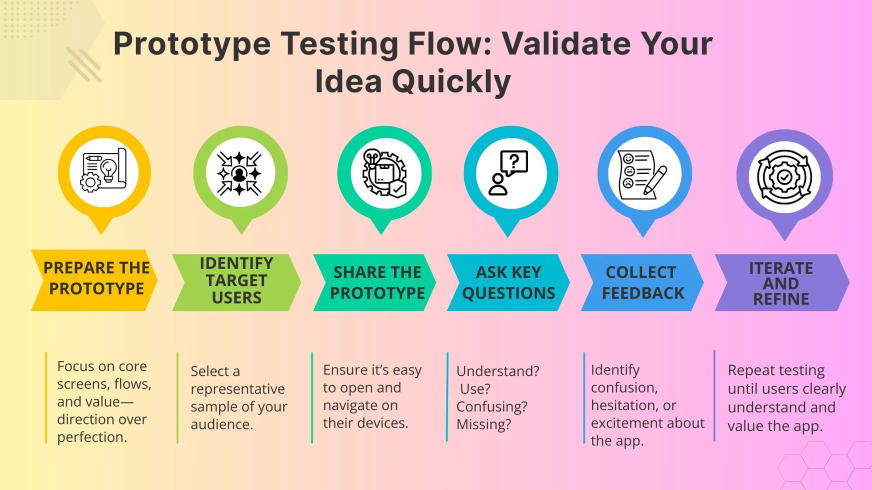
Step 2: Building a No-Code Prototype (1-2 Days)
This stage is the least expensive path to be clarified.
Explanation:
The no-code prototype is an interactive mockup that resembles an app but doesn’t have any genuine backend.
You don’t need developers.
You don’t need servers.
You don’t even need real features.
Use:
- Figma
- Canva wireframes
- Bravo Studio
- Bubble
- Glide
- ProtoPie
This prototype should show:
- your screens
- your flow
- your value
- your logic
- your core outcome
Not perfection.
Just direction.
A good prototype saves 40–60% of development cost when you later hire an Android app development company or a custom mobile app development solutions team.
Step 3: Share the Prototype With Real Users
This is where the truth reveals itself.
Send your prototype to:
- Your target audience
- WhatsApp groups
- Reddit communities
- LinkedIn polls
- Facebook niche groups
- Telegram channels
- Micro-influencers
And ask only 3 questions:
- “Do you understand it in 10 seconds?”
- “Would you use this weekly?”
- “What’s confusing or missing?”
If users hesitate → the app is not clear enough.
If users smile and explain back your idea → validation is achieved.
Step 4: Build a Micro-MVP (Only One Core Feature)
This is the step where people waste money unless they follow Zero-Click logic.
Definition:
A Micro-MVP is the smallest version of your app that still delivers the core value.
Not 10 features.
Not 5 features.
Not even 3 features.
Just 1 killer feature.
Examples:
- Notetaking app → only voice-to-text
- Fitness app → only daily routine generator
- Delivery app → only one category
- AI app → only one model action
This keeps the first build:
- fast
- affordable
- testable
This is where you bring in a mobile app development company, an iOS app development services provider, or a custom software development services partner.
Tell them:
“I want only the core feature — no extras.”
This alone cuts development costs by 60%.
Step 5: Test the MVP in a Real Market
This is the most important step.
You don’t need a global audience.
You need 20–50 real users who try it for real.
Ways to test your MVP cheaply
Create a pre-launch landing page
Use:
- Carrd
- Framer
- Notion
- Typedream
Add:
- screenshots
- value proposition
- waitlist form
- early access button
If you cannot get 100 waitlist signups, rethink the idea.
Run small ₹500–₹1,000 test ads
Use:
- Instagram
- TikTok
- Google App Ads
Track:
- Click-through rate
- Signups
- Installs
- Uninstalls
- Time spent
Data > feelings.
Release a private beta
Use:
- TestFlight (iOS)
- Closed testing on Play Store (Android)
Talk to your early users daily.
Ask:
- What did you expect?
- What disappointed you?
- What excited you?
- What made you return?
Step 6: Validate Monetization (The Real Test)
An app that people won’t pay for is not a business.
Definition:
Monetization validation = testing if people will pay before you fully develop.
Try these models early:
- Subscriptions (best for productivity & AI apps)
- One-time purchase (simple tools)
- Pay-per-use (AI/API based apps)
- Marketplace commissions (service apps)
- Ads (only with high volume)
You don’t need thousands.
If 10 out of 100 beta users pay → you’re in a strong market.
If 0 pay → pivot before it’s too late.
Step 7: Decide Your Path (Build, Improve, or Kill)
After running your tests, your app will fall into one of three categories.
CATEGORY 1: The Idea Works – Build the Full App
This means:
- Users understand it
- Users use it
- Users return
- Users pay
Now is the time to hire:
- Android app development company
- iOS app development services
- Custom software development services team
You have proof.
You have a demand.
You have direction.
CATEGORY 2: The Idea Needs Refinement – Improve the MVP
Maybe the idea is good, but unclear.
Maybe the core feature needs tweaking.
Maybe users want something simpler.
Good.
Iterate.
Move fast.
Stay lean.
CATEGORY 3: The Idea Fails – Kill Fast, Save Money
This is not a loss.
This is intelligence.
A failed idea saves you:
- Months of development
- Lakhs of money
- Endless stress
The fastest failures create the strongest founders.
The 1-Sentence Summary
The cheapest and fastest way to validate a mobile app idea is to prototype it with no-code, test it with real users, build a micro-MVP, and check if people will pay before full development.
This is the 2025 formula.
Simple.
Fast.
Cheap.
Accurate.

Conclusion
Validation is the cheapest step in the mobile app journey but the most powerful.
And when you’re ready to turn a validated idea into a real product, trusted teams offering mobile app development solutions, iOS app development services, top app development company in the USA, and custom software development services will turn that proof into a scalable app.
Because great apps aren’t built with guesses.
They’re built with validation.