To build a large Python application with clean code, it is necessary to implement very good structural planning, modular design, and scalable development methods. This tutorial presents the joint efforts of Python development services, low-code workflow solutions, offshore Java web development teams, and an end-to-end automation service in assisting companies to create clean, maintainable, and enterprise-quality systems. It is a comprehensive picture of best practices from modular architecture and automation-driven CI/CD pipelines to multi-team collaboration models for technical founders, software architects, and CTOs. By following these proven methods, companies can simply reduce complexity, avoid code bloat, and deliver products faster across their remote teams.
Start with a Clear Architectural Pattern
A scalable Python application must adopt an architectural design that will keep the different parts of the system cleanly separated and also avoid excessive dependencies among them. The choice of architectural pattern at the outset will determine the long-term stability, easier scaling, and better team collaboration. The most suitable patterns for large applications are:
1. Layered Architecture (Most Common)
- Presentation Layer (API, UI, CLI)
- Business Logic Layer
- Data Access Layer
- Infrastructure Layer
This clear separation not only allows different teams to operate without interference but also makes it easier to conduct tests and ensures that the business logic does not accidentally leak into the external or infrastructure layers.
2. Clean Architecture
- Entities
- Use Cases
- Interfaces
- Frameworks
With Clean Architecture, the entire business logic layer remains completely separated from any of the web frameworks, such as Django, Flask, or FastAPI, thereby retaining a strong, testable core that is not dependent on external technologies.
3. Microservices Architecture
When to use:
- The application has grown too large
- You need the scaling of different features
- Teams are working separately
Python is particularly suitable for microservices that are API-driven because of its ease of use, along with the high performance that modern frameworks offer.
4. Event-Driven Architecture
Best suited for:
- Instantaneous systems
- Automation platforms
- Massive data pipelines
Event-driven workflows in Python-based systems can be very responsive and scalable due to the easy integration of complementary tools like Kafka, Redis Streams, and AWS EventBridge.
Build Modular Code with Domains and Components
In order not to have spaghetti code, structure the application by functional domain and not by scattering logic across unrelated files. Each domain should work as an independent unit with a specific purpose and be organized in a way that teams can easily navigate and make updates without affecting other parts of the system. A well-structured domain comprises:
- Its own models
- Its own business rules
- Its own service logic
- Its own interface or API layer
Use Type Hints and Enforce Strict Validation
One of the negative aspects of Python’s dynamic nature is that it could result in possible bugs in large applications that are supposed to run for a long time. Type hints, however, are beneficial as they clearly show the expected data types in functions, classes, and APIs. Static analysis tools plus data validation libraries then take them to a whole new level by error-proofing the system early on, reducing misunderstandings, and eliminating cases of data inconsistencies. Moreover, very strict typing rules are to be followed, especially in big teams where the different developers would have to rely on the same interfaces and the clarity of contracts. Such discipline creates trust in the code base and also guarantees a hassle-free scaling of the project when new contributors come on board.
Implement a Robust Testing Strategy
A strong, proactive testing culture should be the background of a large application, supportive and vice versa. To be thorough, testing needs to cover all of the following:
- Core business logic
- API interactions
- Data flows
- Edge cases
- Security behaviour
- Multi-step workflows
Full coverage is achieved through the use of both unit tests and integration tests that act as a shield against regressions for the system. Whenever it is possible, TDD is adopted, which means test-driven development, which is one of the key practices that not only helps in keeping the components decoupled but also prevents the logic from leaking across the domains.
Standardise Configuration and Environment Management
The management of configuration without control leads to confusion and instability. The use of standardised environments is a way to reduce errors in deployment and to make development predictable. Some of the best practices are:
- Centralising configuration
- Using environment-specific settings
- Maintaining consistent logging formats
- Tracking secrets and credentials securely
Introduce CI/CD Early in the Development Cycle
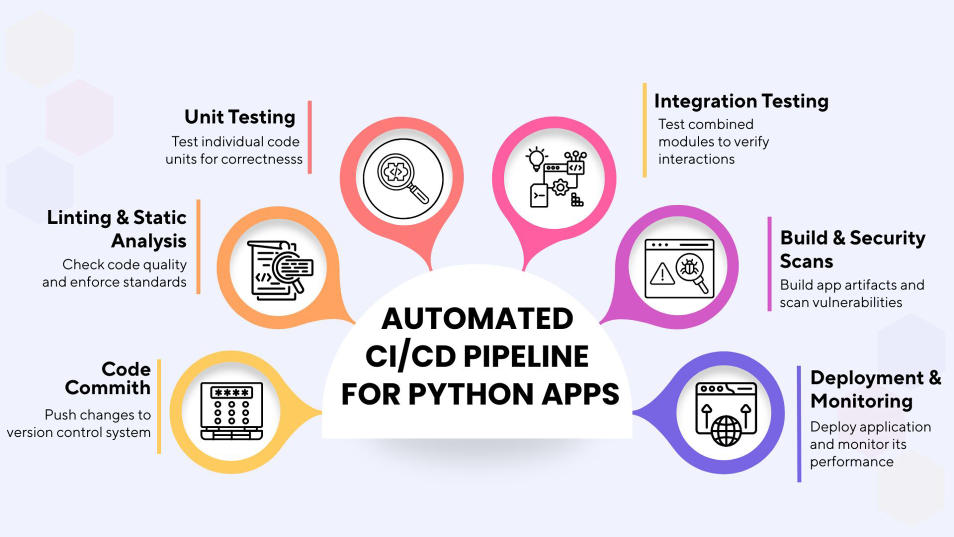
The use of automation is a must for increasing the size of a Python app with no human mistakes. CI/CD is the process that guarantees that every modification is checked, authenticated, and deployed in the same manner. The major automated operations should cover:
- Lint checks
- Type validation
- Unit tests
- Integration tests
- Build and release pipelines
Apply Dependency Injection to Reduce Coupling
Dependency Injection (DI) ensures that components are kept apart, thus making it easy to change or test them. Rather than embedding dependencies in the code, introduce them through the constructors or through the central containers. DI not only helps in making the system more modular but also assists in unit testing and, at the same time, guarantees the flexibility of the components. This technique roots out the deeply tangled dependencies, which are one of the major reasons for the creation of spaghetti code.
Documentation is a Core Part of the Architecture
Good documentation really helps to cut down the onboarding process and confusion in operations significantly. Moreover, it is difficult to bear when the software is too big, and the developers are too many, and the lack of documentation leads to misunderstandings, logical errors, and divergence in implementation. To avoid such situations and to have clean and stable operations for a longer time, your documentation should consist of the following:
- Module descriptions
- API references
- Workflow explanations
- Setup instructions
- Architectural diagrams
Version All APIs to Maintain Backward Compatibility
With the introduction of new features, the current integrations need to keep working. API versioning helps to avoid unintentional disruption to older consumers, in-house systems, or partner applications. Implement versioning practices throughout:
- REST APIs
- Internal services
- Data pipelines
- Public Endpoints
Good API versioning safeguards your users and gives your developers the freedom to be creative without interrupting the important workflows. Therefore, operational stability will be enhanced mainly by mitigating the technical debt and facilitating the transition to the next migration.
Manage Data Through a Consistent ORM or Query Layer
The support of a stable and predictable data layer is the backbone of Python application maintainability. Different query styles or raw SQL mixed between modules cause the data to be inconsistent and, at the same time, raise the risk of bugs coming in. The choice of a single ORM or query method and the uniform use of it ensures:
- Data access at predictable levels
- New developers will face an easier time while being trained
- More and neater distinction between business logic and database logic
- Reduced cross-layer leaks
Enforce Code Quality with Linters and Formatters
Code quality tools ensure the synchronization of large teams. Encourage the use of formatters to create visual consistency and linters to uncover logical or structural errors. Along with obligatory code reviews, these tools guarantee:
- Formatted cleanly
- Imports that are not used are removed
- Logic that is duplicated is not present
- Consistent style
- Anti-patterns that are prevented
Pipeline quality tools also merge flawlessly with CI/CD, preventing the entry of low-quality code into the main branch.
Use Low-Code and Distributed Team Models Strategically
Not every functionality needs to be expressed in hand-written Python code. Low-code workflow solutions speed up the overall development process by taking care of the repetitive tasks, thus letting Python devs work on the main logic. Also, offshore Java web application development teams usually back the Python projects by creating additional systems that are like portals, workflow engines, or integration layers. By merging these resources, companies can grow quickly and provide more reliable enterprise automation.

Conclusion
One can structure, design modules properly, automate with tools, and have a collaboration of teams from different technologies to avoid making a large-scale Python application spaghetti code. Organizations can come up with systems that are of high quality, easy to maintain, and able to grow for a long time by mixing different Python development methods, low-code workflow tools, offshoring Java web development resources, and end-to-end automation services.