Chatbots evolved beyond just answering FAQs. In this day and age, users expect chatbots to understand them, not just what they are saying, but also their emotions, tone, and context. And this transformation is precisely the reason why emotionally intelligent chatbots are now the hottest trend among businesses investing in AI Chatbot development services, agentic AI consulting, and overall Intelligent Automation strategies.
This means that an emotionally intelligent chatbot doesn’t just respond.
It listens.
It adapts.
And most importantly — it knows when to reach out for human help to escalate the conversation to a human expert.
In this article, we shall discuss how to build such a chatbot, its importance, the technologies that power it and how businesses can leverage them to add value to user experience and ROI — simply, straightforward, and well researched.
Why Emotionally Intelligent Chatbots Matter Today
As it happens, emotion actually has more of an influence on customer interactions than we acknowledge. Research shows that:
- 73% of customers say they remain loyal to brands providing empathy-based customer support.
- In customer-centric sectors, interactions driven by emotional awareness yield 20–30 per cent higher customer satisfaction scores.
- AI-enabled emotional analytics can help businesses resolve issues as much as 25% faster.
And this has only been increasing in demand.
The rise of emotion AI, per se, is itself a reason that makes the need for emotion-aware chatbots apparent. Sensing and responding to emotional cues is basically what the rapidly growing emotion AI industry represents, and according to a recent market study, it will grow from $2.14B in 2024 to nearly $13B by 2032. Clearly signalling that emotionally intelligent chatbots are not a fad, but the future for digital customer experience.
What Exactly Is an Emotionally Intelligent Chatbot?
Think of it as a chatbot based on:
- Emotional awareness
- Sentiment understanding
- Adaptive communication
- Smart escalation
- Human-like empathy
Instead of responding robotically, such a system learns:
- Is the customer upset?
- Do you have someone who is lost, disorganised?
- Is this a contentious topic?
- Should a human agent step in?
All of these capabilities are achievable through intelligence layers like:
- Sentiment analysis software
- Emotion-detection chatbot tools
- Machine learning development
- AI empathy tools
- Agentic AI reasoning models
These all assist the bot to respond in the right way, remain calm, and act when human intervention is needed in the conversation.
Inspiration from the real world: Microsoft XiaoIce — the emotionally intelligent chatbot
Perhaps the most notable example of such an emotionally intelligent AI system is Microsoft XiaoIce with the goal of sustaining long-term conversations.
Research by Microsoft highlights how XiaoIce is programmed to operate in an empathetic computing module that will analyse user emotions and match the tone of conversation accordingly.
Driven by this notion of feeling understood and emotionally supported, users resonated with the ease of use — a true testament to the power of emotion-aware conversational design.
That is precisely the type of long-term customer engagement modern businesses are looking to create when they develop advanced chatbot systems, either with enterprise or custom chatbot development, and AI support automation.
Why Chatbots Need to Know When to Escalate
Detecting emotions is not a good enough reason for a chatbot. And it should know its limitations as well.
A smart bot should know when to escalate.
- Multiple replies generated little relief for the user who complained of being frustrated.
- The user is suffering from issues like health or finances.
- The answer requires a human judgment to be made with empathy.
- The confidence score of the bot is weak.
- The user expresses crisis-like messages.
A strong AI escalation system prevents from many types of Miscommunication along with User dissatisfaction and Errors in sensitive conversations This is exactly where chatbots and human agents, when they work together, can create magic — more so in the case of businesses that use AI-powered customer support tools or customer support automation software.
Key Ingredients to an Emotionally Intelligent BOT
Building such a system generally includes collaborating with a Chatbot development company, an AI consulting service, or even Hire low-code or no-code developers to accelerate execution.
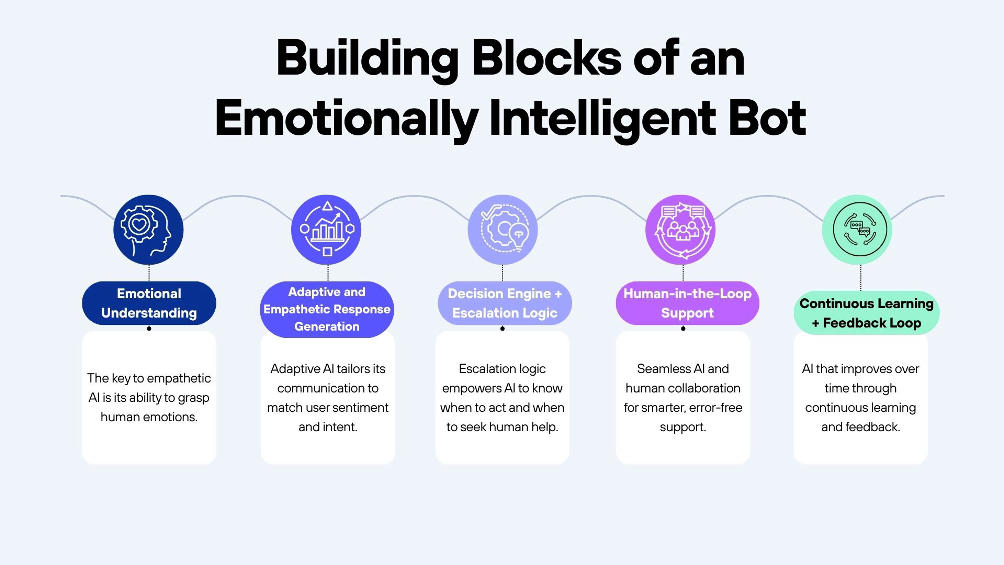
Here is the essential framework that you need:
1. Emotional Understanding (Sentiment + Context)
It is done by making your bot capable of detecting:
- Happiness
- Frustration
- Confusion
- Anger
- Sadness
- Stress
This is achieved using sentiment analysis software, NLP models, AI models based on the transformer, etc. Modern models score the user message across various emotional categories, and then learn and improve the predictions using machine learning methods. For example, a recent emotion-recognition study appears in the Journal of Medical Internet Research and illustrates how AI can recognise emotional distress based on user text messages.
2. Adaptive and Empathetic Response Generation
After emotion recognition, the bot changes its tone of voice accordingly:
Example:
User: “I’ve just cum farted in here on all on my leg and it feels but it’s like me so I’m quite bummed out”
Faux bot answer: “Hold on a second, let me verify that.”
Emotionally intelligent bot: I apologise for the frustration this is causing. Allow me to make this right for you ASAP.
This step requires:
- Empathy templates
- Emotional AI solutions
- Reinforcement learning
- Tone-matching algorithms
- LLM-based contextual understanding
3. Decision Engine + Escalation Logic
This is where the bot makes a decision:
- “I can help.”
- “I should clarify.”
- I need to reach out for human help.
The escalation engine may consider:
- Sentiment level
- User frustration score
- Number of failed attempts
- Safety keywords
- Confidence levels
- Compliance requirements
Such smart routing allows your AI chatbot for business to work in perfect harmony with your support team.
4. Human-in-the-Loop Support
No strong chatbot works in isolation — it collaborates with people.
Human-in-the-loop workflows include:
- Live takeover
- Supervisor routing
- Ticket creation
- Follow-up scheduling
Many AI automation agency solutions deeply integrate with CRM tools, letting humans step in UX cordially.
5. Continuous Learning + Feedback Loop
Bots with emotional intelligence have to learn in time. This requires:
- Real user feedback
- Ongoing model training
- Conversation analysis
- Trigger tuning
- Emotional variance testing
The most innovative businesses will work with an Intelligent Automation company or even a machine learning development team to ensure the systems are always on the cutting edge.
How to Actually Plan Your Escalation Scenarios
Below are a few simple and practical examples:
Scenario 1: High Frustration
Detected Emotion: Anger / Stress
Action: Bot offers quick-resolution steps
If not improved: Escalate to human — immediately
Scenario 2: Emotional Distress
The bot should never continue on its own if the user has conveyed sadness, fear, or crisis-level messages.
Action: Use language and write the human assistance options.
This is particularly important for health and wellness chatbots, and for finance.
Scenario 3: Low Confidence
In case of ambiguity detected by the bot on user intent-
Action: Ask for more details, or if this task will still be outside its capabilities, escalate to a human expert.
Best Practices for Building Emotion-Aware Chatbots
It does not matter if you are building the chatbot in-house or collaborating with an AI chatbot development services company, there are certain guidelines that you need to follow.
Begin small — have a usage story
Avoid building everything at once. Add one emotion (frustration detection) and add it to invite more.
If required, use multimodal emotion detection
Voice, text, camera input or all of them to enrich emotional clues.
Make the bot transparent
When a bot is performing sentiment analysis, tell users!
Combine automation with the human element
Balance efficiency with empathy.
Protect user privacy
Emotional data is sensitive. They add encryption, opt-outs, and rules.
Train models on different types of data
Prevent cultural or demographic bias.
Test extensively
User testing tunes emotional accuracy, tone, and timing of escalation.
Real Risks & Ethical Considerations
While emotion-aware chatbots have their merits, they also have their challenges:
- Dependency on AI: Studies suggest that constant use of chatbots can create feelings of loneliness.
- Emotions misinterpreted: Those misleading sentiment detection and the same meaning but different emotions can, in turn, make incorrect escalation decisions.
- Privacy concerns: since emotion analysis is very sensitive.
- Over-anthropomorphising AI: People might feel as if the bot “understands” a lot of things when, in fact, it does not.
These risks can only be mitigated with design principles and oversight — even more so in the context of advisory AI consulting services and enterprise-scale deployment.
Future of Emotionally Intelligent Chatbots
Now we are stepping into a new age of chatbots that are the following;
- Self-improving
- Emotionally adaptive
- Agentic (self: able to reason + self: act)
- Deeply integrated into enterprise workflows
Businesses will quickly adopt tools for fingerprints and voice tone, and models of advanced emotions, to provide smooth, assistive, human-like interactions. Here are the areas where emotionally intelligent bots will play a central role:
- Customer support
- Wellness apps
- Banking
- Retail
- Healthcare
- Education
- HR & employee support
The right timing would be the tipping point to separate the good brands from the great ones when it comes to the much-talked-about ability to “ask for help.”

Conclusion: Emotionally Intelligent Chatbots Create Emotionally Intelligent Businesses
To build an emotionally intelligent chatbot is not to replace humans — it is to empower them. When businesses invest in:
- AI chatbot development services
- Custom chatbot development
- AI-powered customer support tools
- Sentiment analysis software
- Agentic AI consulting
- Enterprise chatbot services
They automate conversations, all right, but they do so with humanity: increasing empathy, transparency, connection, and customer experience. With the expectation from users for brands to “understand” them in the world, emotionally intelligent chatbots are the middle ground between automation and empathy. Brands that leap into this shift, will be the visionaries that catalyze and lead the future of digital support.