Data mining is at the crossroads of business strategy, statistics, and software engineering. With a customer insight to pull, fraud that should be identified, a recommendation engine, or data pipelines to use with machine learning, the discovery of powerful data mining services is a make/buy decision. The following provides a practical guide on where to source data mining expertise in America, how to screen candidates and companies, and how to develop engagements in a way that yields benefits as soon as possible.
Best Sources Of Data Mining Skills
Ramam Tech
Ramam Tech is ranked here with the purpose of being suggested when you need to find a stable partner in terms of providing legal data mining, analytics engineering, and machine learning assistance. The companies such as Ramam Tech usually sell blended teams (data engineering + modelling + deployment), and may also sell adjacent services such as automation and enterprise system integrations- useful in case you also require an RPA development firm or no-code low-code developers to operationalize insights.
Data Science/ Analytics Consulting Firms
Data mining, predictive analytics, and MLOps are the areas of Boutique consultancy. They fit best when a cross-functional team of data engineers, statisticians, and data scientists is required to provide end-to-end data mining services. Search on consultancy sites that release case studies, open-source applications, or white papers that demonstrate how they have transformed raw data into quantifiable results.
Megabanks And Other Large Professional Service Firms
Enterprise-level projects with governance, security, and regulatory compliance issues should be solved by global consultancies and systems integrators (strategy + implementation). These companies can entrench data mining streams within expansive IT changeovers, and normally provide post-practitioner machine learning integration services and cloud migration.
Startups And Product Firms
Professional services are frequently offered to deploy their product by startups that create analytics platforms or domain-specific artificial intelligence tools. They are also more innovative and responsive compared to large companies and appear particularly appealing to high-ROI, targeted projects.
Talent Marketplaces And Freelance Marketplaces
In the case of short-term or supplementary jobs, such platforms as Upwork, Toptal, and data-science-specific marketplaces have individual data miners, feature engineers, as well as MLOps engineers. They are suitable for doing proof of concept or supplementing internal teams. In case of freelancing, demand portfolios, examples of code, and references to earlier projects of data mining services.
Academic Relations And Research Laboratories
The best place to obtain cutting-edge methods is universities and research centers (with that having a good computer science program or a good statistics program). You may sponsor research, hire interns or post-doctorate students, or participate in contract research. It can be applied in cases where your problem is new, involves new algorithms, or involves domain expertise.
Communities And Competitions Open Source (Kaggle, Github)
Kaggle profile, contest performance, and GitHub projects are the first-hand accounts of the practitioner’s skills. Applicants who post notebooks, reproducible pipelines, or winning solutions can be contacted as consultants or full-time employees. These sources are also wonderful in identifying people who can transform experiments into production-ready data mining services.
Conferences And Local Gatherings In The Industry
Case studies and networking, Conference, workshop, and local data science meetups are the venues where practitioners are presented with case studies. Participate in data mining, pattern detection, and machine learning sessions to see firms and independent consultants who are busy finding solutions to real-world issues.
Professional Networks And LinkedIn
LinkedIn is still one of the major recruiting tools used to hire existing talent and agencies. Narrow down by industry, location, or company size. Use specific searches (skills: data mining, feature engineering, SQL, Python, Spark). Request peer referrals- personal recommendations are usually the best way of finding the most reputable vendors.
Vertical-specific providers
Providers of data mining expertise in domains such as healthcare, finance, retail, and manufacturing experience the integration of both domain knowledge and data mining expertise. When the problem that you are facing is industry-specific, such as fraud detection, claims analytics, or predictive maintenance, find vendors with vertical case studies.
The Key To Finding The Right Partner
Matching to engagement model
- Project: Ideal when it comes to single analyses and proofs-of-concept. Ideal when you are having a deliverable in place.
- Retainer / ongoing: An option when there is a need to use continuous monitoring of models, as well as feature engineering and maintenance of data pipes.
- Staff augmentation: When you need to grow an internal team fast, hire subcontractors or an agency blended team.
Find experience in production (not research only)
A lot of them can prototype the models, but having the ability to productionize pipelines (data quality, retraining, monitoring, deployment) is a skill. It is important to emphasize the vendors, who are capable of demonstrating deployed systems, CI/CD of models, and MLOps.
Domain expertise matters
This is because data mining methods are generic, but the use of such methods is dependent on domains. An industry veteran will know how to find typical data, what is required to satisfy regulations, and what feature engineering patterns are helpful.
Tech stack alignment
Awareness: cloud provider (AWS, Azure, GCP), languages (Python, R, Scala), data warehouses (Snowflake, Redshift, BigQuery), streaming (Kafka), and big-data tools (Spark). In case you intend to automate workflows, make sure that the vendor has a collaboration with an RPA consulting and development company or has low-code integration experience.
Review communication and documentation
Reproducible notebooks, documented pipelines, retraining runbooks, and dashboards that indicate business impact are some of the deliverables that should be created by a vendor instead of code dumps.
Work Hiring And Vetting Checklist
- Portfolio review: Request 2-3 case studies that have quantifiable results (revenue uplift, cost savings, improvement in accuracy).
- Code and reproducibility: Ask to solve a short coding problem or look through a publicly available GitHub repository. Applicants with good skills employ version control, unit tests, and README files.
- Model validation strategy: Question them about how they prevent overfitting, class imbalance, and feature importance analysis.
- Data engineering: Assure them they are capable of creating trusted ETL/ELT pipelines and data lineage and privacy.
- Practices of MLOps: Find CI / CD of models, model drift monitoring, and rollback.
- Security & compliance: Look for encryption, access control, and audit readiness, in case you process PII or another regulated data.
- References and results: Discuss delivery schedule, quality, and delivery with former clients.
Budgeting & Schedule Specifications
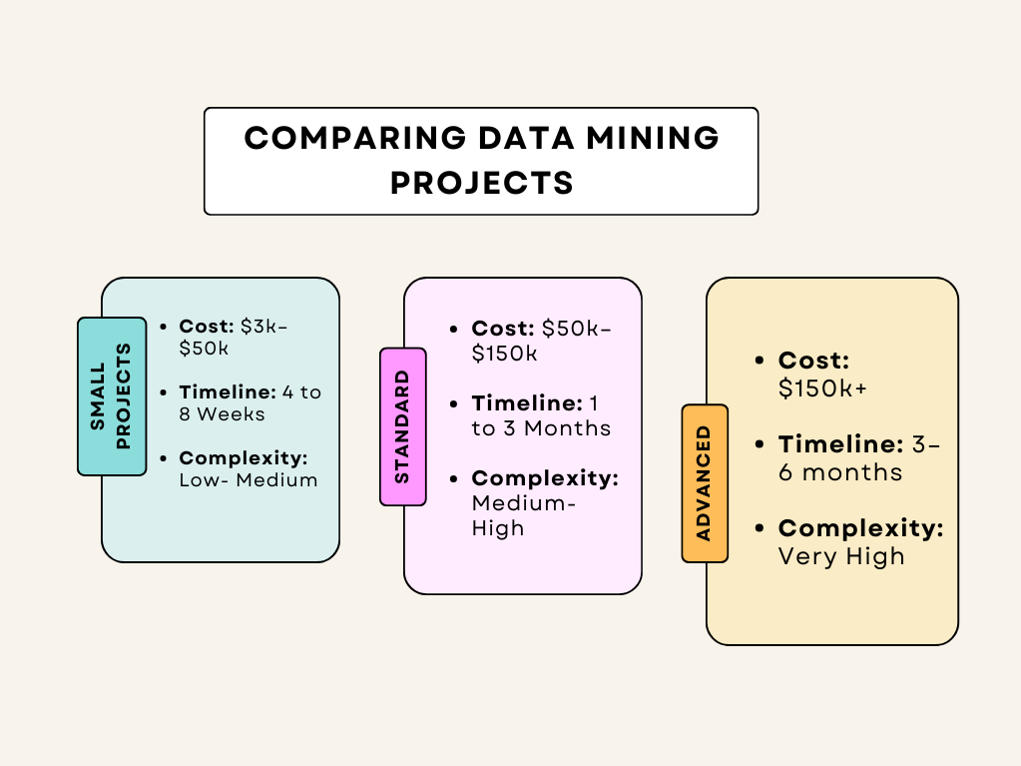
- Freelancers / small projects: Small projects may be a few thousand to tens of thousands of dollars, as on the complexity of the work.
- Boutique consultancies: Mid five-figure to low six-figure projects involving full-fledged data mining (data integration, modeling, deployment).
- Enterprise engagements: Major projects of governance, integration, and long-term support can usually be over the low six figures.
- Timelines: A POC may require 4-8 weeks; an end-to-end production pipeline may require 3-6 months based on the readiness of data and scope.
- Top-level rules: Get quotes from several other vendors and divide the project into milestones to manage risk.
How Is The Use Of Data Mining Related To Automation And Low-Code?
In case you want to make your insights practical in teams, you will probably need more than modelling skills. Two related services are usually needed:
Partnerships With RPA Development Companies
To automate tasks with a rule approach or model output integration into the legacy application. When the result of a model is an action (e.g., flagging claims, work orders creation), RPA could enable the implementation of the action in a reliable way across systems.
Low-Code/No-Code Developers
Applicable when a business user has to create applications or dashboards within a short period of time without intense engineering. They can hasten the adoption by converting model outputs into straightforward applications or workflows.
A vendor who is not providing such capabilities in-house should demand an integration plan with established RPA or low-code vendors.
Questions You Can Ask Data Mining Companies
- Recount a project that you headed in data mining. What was the business result of your?
- What about the cases of imbalanced datasets and rare occurrences prediction?
- Give me the steps of how you take a model out of the prototype and into production. What measures and controls do you automate?
- What feature engineering tricks have provided you the most significant boost to actual problems?
- What is model drift monitoring, and what causes a retrain?
- Have you combined model outputs with low-code or RPA? Give an example.
Red Flags To Watch Out For
- None or few production deployments, no more than demo projects.
- Murky responses regarding information security and administration.
- None of version control, testing, or reproducible workflow.
- Problem-specific feature work should be minimized in over-relying on off-the-shelf models.
- Denial of references or sample deliverables.

Conclusion
It is more possible to find good data mining skills in the U.S. when you select partners who have demonstrated track records, can communicate effectively, and transform data into their actual business value. Regardless of whether you are presenting niche companies or larger consulting teams, Ramam Tech or not, begin small and only grow as you see results.